Ch. 4 - Acids and Bases/Electron Flow
Mullins - Organic Chemistry: A Learner Centered Approach 1st Edition
Mullins1st EditionOrganic Chemistry: A Learner Centered ApproachISBN: 9780137566471Non è quello che usi tu?Cambia libro di testo
Capitolo 3, Problema 56a

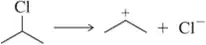
Show an arrow-pushing mechanism that forms the product on the right from the reactant at left. Only one arrow is necessary in each reaction. [Don't forget to draw in the lone pairs on this and the next two assessments.]
(a)

Guida verificata passo dopo passo
1
Step 1: Identify the reactant and product. The reactant is a tertiary alkyl chloride, and the product is a carbocation along with a chloride ion. This suggests an SN1 reaction mechanism.
Step 2: Recognize that the bond between the carbon atom and the chlorine atom will break heterolytically. This means the electrons in the bond will move entirely to the chlorine atom, forming a chloride ion (Cl⁻).
Step 3: Use curved arrow notation to show the movement of electrons. Draw an arrow starting from the bond between the carbon and chlorine atoms and pointing toward the chlorine atom. This represents the bond cleavage.
Step 4: After the bond breaks, the carbon atom becomes positively charged, forming a carbocation. The chlorine atom gains the pair of electrons, resulting in a chloride ion with a full octet.
Step 5: Ensure that lone pairs are drawn on the chlorine atom in the product to indicate its complete octet. Verify that the carbocation is correctly represented with a positive charge on the central carbon atom.

Risposta video verificata per un problema simile:

Questa soluzione video è stata consigliata dai nostri tutor come utile per risolvere questo problema.
Durata del video:
1m

Concetti chiave

Ecco i concetti essenziali che devi comprendere per rispondere correttamente alla domanda.

Arrow-Pushing Mechanism

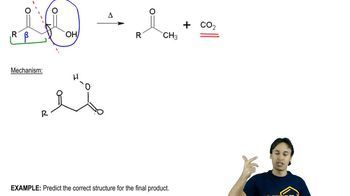
Arrow-pushing mechanisms are a way to illustrate the movement of electrons during chemical reactions. In these diagrams, arrows represent the flow of electron pairs, indicating how bonds are formed or broken. Understanding this mechanism is crucial for predicting the products of reactions and visualizing the transition states involved.
Video consigliato:
04:32
General Mechanism

Lone Pairs

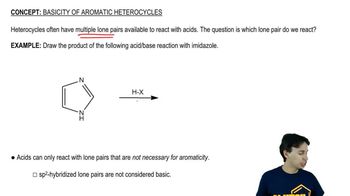
Lone pairs are pairs of valence electrons that are not involved in bonding and are localized on an atom. They play a significant role in determining the reactivity and geometry of molecules. In arrow-pushing mechanisms, it is important to represent lone pairs accurately, as they can participate in reactions or influence the stability of intermediates.
Video consigliato:
02:04
Heterocycles - Which lone pairs react?

Electrophiles and Nucleophiles

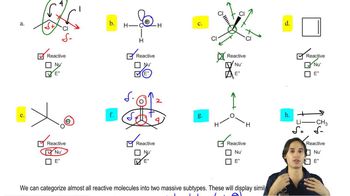
Electrophiles are electron-deficient species that seek electrons, while nucleophiles are electron-rich species that donate electrons. In the context of the provided reaction, recognizing which species acts as the electrophile and which as the nucleophile is essential for understanding the direction of electron flow and the formation of the product.
Video consigliato:
03:
Nucleophile or Electrophile