Ch. 4 - Acids and Bases/Electron Flow
Mullins - Organic Chemistry: A Learner Centered Approach 1st Edition
Mullins1st EditionOrganic Chemistry: A Learner Centered ApproachISBN: 9780137566471Non è quello che usi tu?Cambia libro di testo
Capitolo 3, Problema 33

If a base has a conjugate acid with a high pKa value, is it stable or unstable? How do you know this is true (besides 'I just remember')?

Guida verificata passo dopo passo
1
Understand the relationship between pKₐ and acid strength: A high pKₐ value indicates a weak acid, meaning the acid does not readily donate protons (H⁺). This is because the equilibrium for proton dissociation lies far to the left, favoring the undissociated form of the acid.
Recall the conjugate acid-base relationship: A weak acid has a strong conjugate base. This is because the weak acid does not easily lose its proton, so its conjugate base is more likely to accept a proton, making it a strong base.
Analyze the stability of the base: A strong base is less stable because it has a high tendency to react with protons (H⁺) to form its conjugate acid. Stability is inversely related to reactivity; the more reactive a base, the less stable it is.
Connect the pKₐ value to the base's stability: Since a high pKₐ value corresponds to a weak acid and a strong conjugate base, the base in question is less stable. This is because it is highly reactive and eager to accept protons.
Summarize the reasoning: The stability of a base is determined by the strength of its conjugate acid. A high pKₐ value for the conjugate acid means the base is strong and therefore less stable due to its high reactivity.

Risposta video verificata per un problema simile:

Questa soluzione video è stata consigliata dai nostri tutor come utile per risolvere questo problema.
Durata del video:
4m

Concetti chiave

Ecco i concetti essenziali che devi comprendere per rispondere correttamente alla domanda.

Conjugate Acid-Base Pairs

In acid-base chemistry, a conjugate acid is formed when a base accepts a proton (H⁺). The strength of the acid is often measured by its pKₐ value, which is the negative logarithm of its acid dissociation constant (Kₐ). A high pKₐ indicates a weak acid, meaning it does not dissociate easily in solution, which is a key factor in determining the stability of the conjugate acid.
Video consigliato:
Percorso guidato
2:56
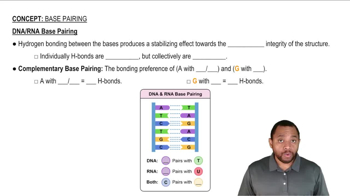
Base Pairing Concept 1

Stability of Conjugate Acids

The stability of a conjugate acid is influenced by its ability to hold onto the proton it has gained. A conjugate acid with a high pKₐ value is typically more stable because it is less likely to donate the proton back to the solution. This stability can be attributed to factors such as electronegativity, resonance, and the overall structure of the molecule, which affect how well the positive charge is delocalized.
Video consigliato:
04:31
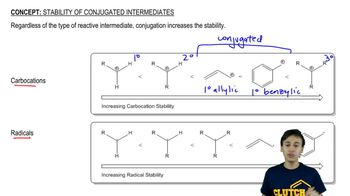
Stability of Conjugated Intermediates

Relationship Between pKₐ and Acid Strength

The pKₐ value is inversely related to the strength of an acid; lower pKₐ values correspond to stronger acids that dissociate more readily. Therefore, when considering a base with a conjugate acid that has a high pKₐ, it indicates that the conjugate acid is weak and stable. This relationship helps predict the behavior of acids and bases in chemical reactions and their relative stabilities.
Video consigliato:
01:40
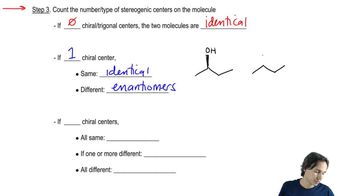
Same atoms, same connectivity, 1 chiral center.