Ch. 4 - Acids and Bases/Electron Flow
Mullins - Organic Chemistry: A Learner Centered Approach 1st Edition
Mullins1st EditionOrganic Chemistry: A Learner Centered ApproachISBN: 9780137566471Non è quello che usi tu?Cambia libro di testo
Capitolo 3, Problema 30b

Given that the indicated pKa values correspond to the acid dissociation reactions shown, calculate the ratio of acid to conjugate base for the reactions shown.
(b) Chemical equation showing acid dissociation with pKa value of 9, illustrating equilibrium between acid and conjugate base.

Guida verificata passo dopo passo
1
Step 1: Understand the relationship between pKₐ and the acid dissociation constant (Kₐ). The pKₐ value is defined as pKₐ = -log(Kₐ). This value helps determine the strength of the acid and its dissociation behavior in solution.
Step 2: Recall the Henderson-Hasselbalch equation, which relates the pH of a solution to the pKₐ and the ratio of acid to conjugate base: \( \text{pH} = \text{pKₐ} + \log \left( \frac{[\text{A}^-]}{[\text{HA}]} \right) \). Here, \([\text{HA}]\) represents the concentration of the acid, and \([\text{A}^-]\) represents the concentration of the conjugate base.
Step 3: Rearrange the Henderson-Hasselbalch equation to solve for the ratio of acid to conjugate base: \( \frac{[\text{HA}]}{[\text{A}^-]} = 10^{\text{pKₐ} - \text{pH}} \). This equation allows you to calculate the ratio directly once the pH and pKₐ values are known.
Step 4: Substitute the given pKₐ value and the pH of the solution into the rearranged equation. Ensure that the pH value corresponds to the conditions of the reaction being analyzed.
Step 5: Perform the calculation using the substituted values to determine the ratio of acid to conjugate base. The result will indicate the relative concentrations of the acid and its conjugate base in the solution.

Risposta video verificata per un problema simile:

Questa soluzione video è stata consigliata dai nostri tutor come utile per risolvere questo problema.
Durata del video:
7m

Concetti chiave

Ecco i concetti essenziali che devi comprendere per rispondere correttamente alla domanda.

pKₐ and Acid-Base Equilibrium

pKₐ is a measure of the strength of an acid in solution, defined as the negative logarithm of the acid dissociation constant (Kₐ). It indicates how readily an acid donates protons (H⁺) to form its conjugate base. A lower pKₐ value signifies a stronger acid, which dissociates more completely in solution. Understanding pKₐ is essential for calculating the ratio of acid to conjugate base in equilibrium.
Video consigliato:
04:00
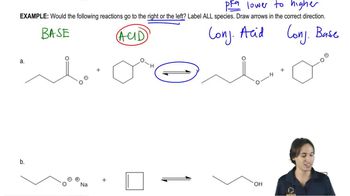
Determining Acid/Base Equilibrium

Henderson-Hasselbalch Equation

The Henderson-Hasselbalch equation relates the pH of a solution to the pKₐ of an acid and the ratio of the concentrations of its conjugate base and acid. It is expressed as pH = pKₐ + log([A⁻]/[HA]), where [A⁻] is the concentration of the conjugate base and [HA] is the concentration of the acid. This equation is crucial for determining the desired ratio of acid to conjugate base in buffer solutions.
Video consigliato:
05:02
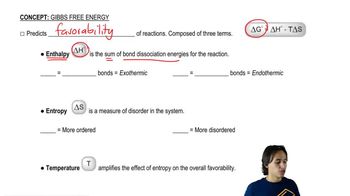
Breaking down the different terms of the Gibbs Free Energy equation.

Acid-Base Reaction Dynamics

Acid-base reactions involve the transfer of protons between species, leading to the formation of conjugate acids and bases. The position of equilibrium in these reactions is influenced by the relative strengths of the acids and bases involved, as well as their concentrations. Understanding these dynamics is vital for calculating the ratios of acid to conjugate base, as it helps predict how changes in concentration or pH will affect the equilibrium state.
Video consigliato:
02:49
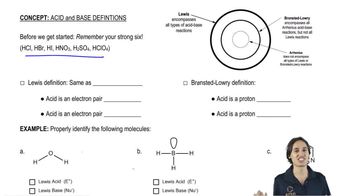
The Lewis definition of acids and bases.