Ch. 4 - Acids and Bases/Electron Flow
Mullins - Organic Chemistry: A Learner Centered Approach 1st Edition
Mullins1st EditionOrganic Chemistry: A Learner Centered ApproachISBN: 9780137566471Non è quello che usi tu?Cambia libro di testo
Capitolo 3, Problema 17c

Provide an arrow-pushing mechanism for the following hypothetical base half-reactions.
(c) Arrow-pushing mechanism illustrating the reaction between a base and a proton, showing the formation of ammonium ion.

Guida verificata passo dopo passo
1
Identify the base in the reaction. A base is a species that donates a pair of electrons to accept a proton (H⁺). Look for a lone pair of electrons or a negative charge on the base molecule.
Locate the acidic proton (H⁺) in the reaction. This is typically a hydrogen atom bonded to an electronegative atom, such as oxygen or nitrogen, which makes it more likely to be donated.
Draw a curved arrow starting from the lone pair of electrons on the base and pointing toward the acidic proton. This represents the base using its electrons to form a bond with the proton.
If the acidic proton is part of a bond (e.g., O-H or N-H), draw a second curved arrow starting from the bond between the proton and its atom, pointing toward the atom (e.g., oxygen or nitrogen). This shows the bond breaking and the electrons moving to the electronegative atom.
Verify the products of the reaction. The base should now have gained a proton (forming its conjugate acid), and the acidic molecule should have lost a proton (forming its conjugate base). Ensure the charges and electron counts are balanced in the final structures.

Risposta video verificata per un problema simile:

Questa soluzione video è stata consigliata dai nostri tutor come utile per risolvere questo problema.
Durata del video:
1m

Concetti chiave

Ecco i concetti essenziali che devi comprendere per rispondere correttamente alla domanda.

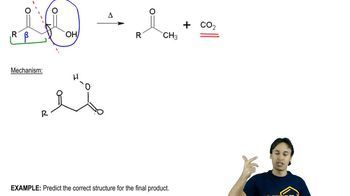
Arrow-Pushing Mechanism

The arrow-pushing mechanism is a visual representation used in organic chemistry to illustrate the movement of electrons during chemical reactions. Arrows indicate the direction of electron flow, showing how bonds are formed or broken. This technique is essential for understanding reaction mechanisms, particularly in acid-base reactions, where proton transfer occurs.
Video consigliato:
04:32
General Mechanism

Acid-Base Reactions

Acid-base reactions involve the transfer of protons (H+) between reactants. An acid is defined as a proton donor, while a base is a proton acceptor. Understanding the strength of acids and bases, as well as their conjugate pairs, is crucial for predicting the outcome of these reactions and for applying the arrow-pushing mechanism effectively.
Video consigliato:
02:49
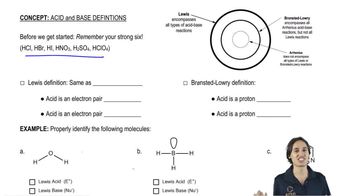
The Lewis definition of acids and bases.

Conjugate Acid-Base Pairs

Conjugate acid-base pairs consist of two species that differ by the presence or absence of a proton. When an acid donates a proton, it forms its conjugate base, and when a base accepts a proton, it forms its conjugate acid. Recognizing these pairs is vital for understanding the equilibrium of acid-base reactions and for applying the arrow-pushing mechanism correctly.
Video consigliato:
Percorso guidato
2:56
Base Pairing Concept 1