Ch. 4 - Acids and Bases/Electron Flow
Mullins - Organic Chemistry: A Learner Centered Approach 1st Edition
Mullins1st EditionOrganic Chemistry: A Learner Centered ApproachISBN: 9780137566471Non è quello che usi tu?Cambia libro di testo
Capitolo 3, Problema 49

Rank the following amines in order of their basicity (strongest base = 1 ; weakest base = 6).
Chemical structures of six amines, labeled for ranking their basicity from strongest to weakest.

Guida verificata passo dopo passo
1
Identify the amines in the given list and note their structural features, such as alkyl groups, aromatic rings, or electron-withdrawing/donating substituents. These features influence the basicity of the amine.
Recall that the basicity of an amine is determined by the availability of the lone pair of electrons on the nitrogen atom. Electron-donating groups increase basicity by making the lone pair more available, while electron-withdrawing groups decrease basicity by delocalizing or withdrawing electron density.
Consider the effect of resonance. For example, if the nitrogen's lone pair is delocalized into an aromatic ring (as in aniline derivatives), the basicity decreases because the lone pair is less available for protonation.
Evaluate the inductive effects of substituents. Alkyl groups are electron-donating via the inductive effect, which increases basicity, while electronegative atoms or groups (e.g., halogens, nitro groups) are electron-withdrawing and decrease basicity.
Rank the amines based on the combined effects of resonance, inductive effects, and steric hindrance, starting with the strongest base (most available lone pair) as 1 and ending with the weakest base (least available lone pair) as 6.

Risposta video verificata per un problema simile:

Questa soluzione video è stata consigliata dai nostri tutor come utile per risolvere questo problema.
Durata del video:
2m

Concetti chiave

Ecco i concetti essenziali che devi comprendere per rispondere correttamente alla domanda.

Basicity of Amines

Basicity in amines refers to their ability to accept protons (H+) from acids. This property is influenced by the availability of the lone pair of electrons on the nitrogen atom, which can bond with protons. The more readily an amine can donate its lone pair, the stronger its basicity.
Video consigliato:
07:12
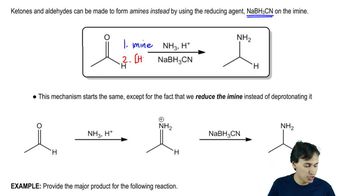
Reductive Amination

Inductive Effect

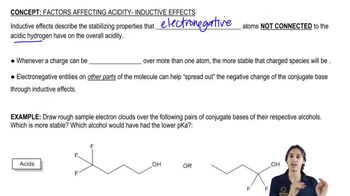
The inductive effect describes how electron-withdrawing or electron-donating groups attached to the amine can influence its basicity. Electron-donating groups (like alkyl groups) increase basicity by stabilizing the positive charge on the nitrogen when it accepts a proton, while electron-withdrawing groups decrease basicity by destabilizing this charge.
Video consigliato:
01:47
Understanding the Inductive Effect.

Steric Hindrance

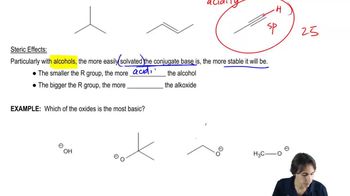
Steric hindrance refers to the spatial arrangement of atoms around the nitrogen in an amine, which can affect its ability to interact with protons. Bulky groups near the nitrogen can hinder access to the lone pair, reducing basicity. Thus, the size and arrangement of substituents play a crucial role in determining the overall basicity of amines.
Video consigliato:
02:53
Understanding steric effects.