Ch. 4 - Acids and Bases/Electron Flow
Mullins - Organic Chemistry: A Learner Centered Approach 1st Edition
Mullins1st EditionOrganic Chemistry: A Learner Centered ApproachISBN: 9780137566471Non è quello che usi tu?Cambia libro di testo
Capitolo 3, Problema 48

Rank the following alcohols in order of descending pKa value. Explain your ranking.

Guida verificata passo dopo passo
1
Step 1: Understand the concept of pKa. The pKa value of an alcohol is a measure of its acidity. Lower pKa values indicate stronger acids, while higher pKa values indicate weaker acids. The acidity of alcohols is influenced by the stability of the conjugate base formed after deprotonation.
Step 2: Analyze the substituents attached to the alcohols. Electronegative substituents, such as halogens (F, Cl, I), stabilize the conjugate base through inductive effects, making the alcohol more acidic (lower pKa). The closer the electronegative group is to the hydroxyl group, the stronger the inductive effect.
Step 3: Compare the alcohols in the image. For example: (1) The alcohol with iodine directly attached to the carbon bearing the hydroxyl group will have a weaker inductive effect due to iodine's lower electronegativity compared to fluorine or chlorine. (2) Alcohols with fluorine substituents will exhibit the strongest inductive effects due to fluorine's high electronegativity. (3) Alcohols with chlorine substituents will have intermediate inductive effects.
Step 4: Consider the number and position of electronegative substituents. Alcohols with multiple fluorine atoms (e.g., trifluoromethyl alcohol) will have the lowest pKa due to the cumulative inductive effect. Alcohols with halogens farther from the hydroxyl group will have less impact on acidity.
Step 5: Rank the alcohols based on their substituents and inductive effects. Alcohols with fluorine substituents closest to the hydroxyl group will have the lowest pKa, followed by alcohols with chlorine substituents, and then alcohols with iodine substituents. Alcohols without halogens will have the highest pKa.

Risposta video verificata per un problema simile:

Questa soluzione video è stata consigliata dai nostri tutor come utile per risolvere questo problema.

Concetti chiave

Ecco i concetti essenziali che devi comprendere per rispondere correttamente alla domanda.

Acidity of Alcohols

The acidity of alcohols is determined by the stability of their conjugate bases after deprotonation. A more stable conjugate base corresponds to a stronger acid, which is reflected in a lower pKa value. Factors influencing acidity include the electronegativity of substituents and their ability to stabilize negative charge through inductive effects or resonance.
Video consigliato:
02:02
Forming alcohols through Acid-Catalyzed Hydration.

Inductive Effect

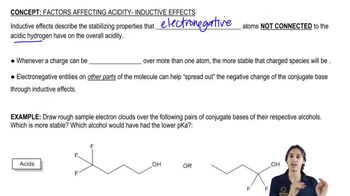
The inductive effect refers to the electron-withdrawing or electron-donating effects of substituents on a molecule. Electronegative atoms, such as fluorine and chlorine, can stabilize the negative charge on the conjugate base of an alcohol, thereby increasing its acidity. The strength of this effect diminishes with distance from the functional group, making proximity crucial in determining acidity.
Video consigliato:
01:47
Understanding the Inductive Effect.

Comparative Analysis of Substituents

When ranking the acidity of alcohols, it is essential to compare the effects of different substituents on the carbon chain. For instance, halogens like fluorine and chlorine are strong electron-withdrawing groups, enhancing acidity, while alkyl groups are electron-donating and decrease acidity. The overall ranking of pKa values will depend on the combination and position of these substituents.
Video consigliato:
02:41
Comparing hydrocarbon acidity