Ch. 4 - Acids and Bases/Electron Flow
Mullins - Organic Chemistry: A Learner Centered Approach 1st Edition
Mullins1st EditionOrganic Chemistry: A Learner Centered ApproachISBN: 9780137566471Non è quello che usi tu?Cambia libro di testo
Capitolo 3, Problema 45a

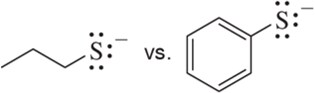
Which anion in each pair would you expect to react more quickly with H+?
(a) Comparison of two anions: a linear structure on the left and a phenyl group on the right, both with negative charges.

Guida verificata passo dopo passo
1
Identify the two anions in the pair and analyze their structures. Consider factors such as resonance stabilization, electronegativity, and the availability of lone pairs for protonation.
Recall that an anion's reactivity with H⁺ (a proton) depends on its basicity. A stronger base will react more quickly with H⁺ because it has a greater tendency to accept a proton.
Examine the resonance effects: If one anion is resonance-stabilized, it will be less basic because the negative charge is delocalized, making it less available to react with H⁺.
Consider the inductive effects: If an anion has electronegative atoms or groups nearby, they can withdraw electron density, reducing the anion's basicity and reactivity with H⁺.
Compare the two anions based on the above factors and determine which one is more basic and thus more likely to react quickly with H⁺.

Risposta video verificata per un problema simile:

Questa soluzione video è stata consigliata dai nostri tutor come utile per risolvere questo problema.
Durata del video:
2m

Concetti chiave

Ecco i concetti essenziali che devi comprendere per rispondere correttamente alla domanda.

Acidity and Basicity

Acidity refers to the ability of a substance to donate protons (H⁺), while basicity is the ability to accept protons. In organic chemistry, the strength of an acid or base can influence the reactivity of anions. A stronger base will typically react more quickly with protons, making it essential to understand the relative strengths of acids and bases when predicting reaction rates.
Video consigliato:
06:21
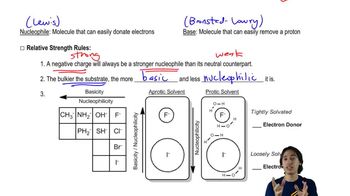
Understanding the difference between basicity and nucleophilicity.

Nucleophilicity

Nucleophilicity is a measure of how readily a species donates an electron pair to form a bond with a proton or electrophile. Anions, being negatively charged, are often nucleophiles. The more nucleophilic an anion is, the faster it will react with H⁺. Factors such as charge, electronegativity, and steric hindrance affect nucleophilicity.
Video consigliato:
08:27
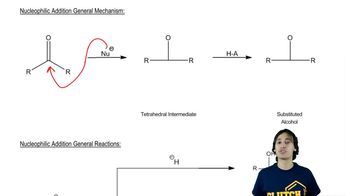
Nucleophilic Addition

Reaction Mechanisms

Understanding reaction mechanisms is crucial for predicting how and why certain reactions occur. In the context of anions reacting with H⁺, the mechanism can involve protonation steps that determine the rate of reaction. Familiarity with common mechanisms, such as acid-base reactions and nucleophilic attacks, helps in analyzing which anion will react more quickly.
Video consigliato:
02:16
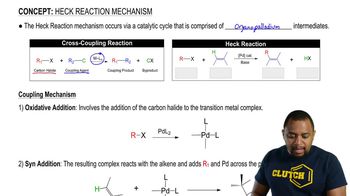
Heck Reaction Mechanism