Ch. 4 - Acids and Bases/Electron Flow
Mullins - Organic Chemistry: A Learner Centered Approach 1st Edition
Mullins1st EditionOrganic Chemistry: A Learner Centered ApproachISBN: 9780137566471Non è quello che usi tu?Cambia libro di testo
Capitolo 3, Problema 46a

Which acid in each pair would you expect to more readily donate a proton to a basic compound?
(a)

Guida verificata passo dopo passo
1
Step 1: Analyze the chemical structures provided. The first compound is pyrrole, which has a nitrogen atom in a five-membered aromatic ring. The second compound is pyrrolidine, which has a nitrogen atom in a five-membered saturated ring.
Step 2: Consider the acidity of the compounds. Acidity is influenced by the stability of the conjugate base formed after donating a proton. In pyrrole, the conjugate base is stabilized by resonance because the negative charge on nitrogen can delocalize into the aromatic ring. In pyrrolidine, the conjugate base lacks resonance stabilization.
Step 3: Evaluate the hybridization of the nitrogen atom. In pyrrole, the nitrogen is sp2 hybridized due to its involvement in the aromatic system, which makes the N-H bond more acidic. In pyrrolidine, the nitrogen is sp3 hybridized, which is less acidic.
Step 4: Consider the electron density around the nitrogen atom. In pyrrole, the aromatic ring withdraws electron density from the nitrogen, making it easier to donate a proton. In pyrrolidine, the saturated ring does not have this electron-withdrawing effect.
Step 5: Conclude that pyrrole is more likely to donate a proton to a basic compound compared to pyrrolidine due to the resonance stabilization of its conjugate base and the electron-withdrawing effects of the aromatic ring.

Risposta video verificata per un problema simile:

Questa soluzione video è stata consigliata dai nostri tutor come utile per risolvere questo problema.

Concetti chiave

Ecco i concetti essenziali che devi comprendere per rispondere correttamente alla domanda.

Acid Strength

Acid strength refers to the ability of an acid to donate protons (H+) to a base. Stronger acids have a greater tendency to lose protons compared to weaker acids. This is often determined by the stability of the conjugate base formed after the proton donation; more stable conjugate bases correspond to stronger acids.
Video consigliato:
03:09
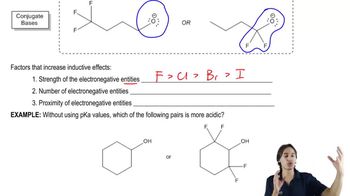
The 3 factors that determine the strength of inductive effects.

Conjugate Base Stability

The stability of a conjugate base is crucial in determining acid strength. Factors such as electronegativity, resonance, and inductive effects influence this stability. A more stable conjugate base will result from a stronger acid, as the equilibrium will favor the dissociation of the acid into its conjugate base and a proton.
Video consigliato:
04:31
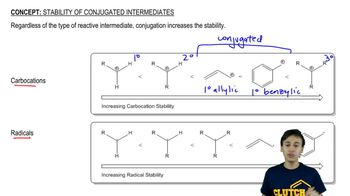
Stability of Conjugated Intermediates

pKa Values

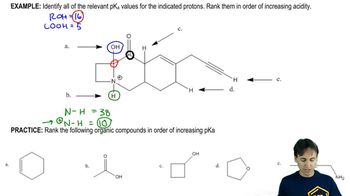
The pKa value is a quantitative measure of acid strength, representing the negative logarithm of the acid dissociation constant (Ka). Lower pKa values indicate stronger acids, as they correspond to a higher tendency to donate protons. Comparing pKa values of acids in a pair can help predict which acid is more likely to donate a proton.
Video consigliato:
07:45
Identifying pKa values