Ch. 5 - Chemical Reaction Analysis: Thermodynamics and Kinetics
Mullins - Organic Chemistry: A Learner Centered Approach 1st Edition
Mullins1st EditionOrganic Chemistry: A Learner Centered ApproachISBN: 9780137566471Non è quello che usi tu?Cambia libro di testo
Capitolo 4, Problema 49a

For each of the following reactions, identify the bonds that are broken and formed. Be sure to indicate whether the bond that is broken is a σ bond or a π bond.
(a) Chemical reaction showing the interaction of hydroxide and bromine, resulting in a product and hydrogen bromide.

Guida verificata passo dopo passo
1
Step 1: Analyze the reactants and products. The reactants are acetic acid (CH3COOH) and isopropyl bromide ((CH3)2CHBr). The products are isopropyl acetate (CH3COOCH(CH3)2) and HBr.
Step 2: Identify the bonds broken in the reaction. In acetic acid, the O-H σ bond is broken. In isopropyl bromide, the C-Br σ bond is broken.
Step 3: Identify the bonds formed in the reaction. A new C-O σ bond is formed between the carbonyl oxygen of acetic acid and the isopropyl group. Additionally, an H-Br σ bond is formed.
Step 4: Classify the bonds broken and formed. Both the bonds broken (O-H and C-Br) and the bonds formed (C-O and H-Br) are σ bonds. No π bonds are involved in this reaction.
Step 5: Summarize the reaction mechanism. This is an example of a nucleophilic acyl substitution reaction, where the nucleophile (isopropyl group) replaces the hydroxyl group of acetic acid, forming an ester and HBr as byproducts.

Risposta video verificata per un problema simile:

Questa soluzione video è stata consigliata dai nostri tutor come utile per risolvere questo problema.

Concetti chiave

Ecco i concetti essenziali che devi comprendere per rispondere correttamente alla domanda.

Types of Chemical Bonds

In organic chemistry, bonds between atoms can be classified as sigma (σ) or pi (π) bonds. Sigma bonds are formed by the head-on overlap of atomic orbitals and are the first bonds formed between two atoms. Pi bonds, on the other hand, result from the side-to-side overlap of p orbitals and are typically found in double and triple bonds. Understanding these bond types is crucial for analyzing reactions.
Video consigliato:
Percorso guidato
3:11
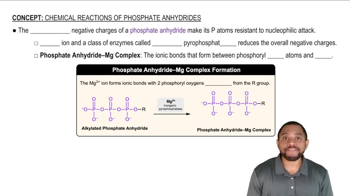
Chemical Reactions of Phosphate Anhydrides Concept 1

Reaction Mechanisms

A reaction mechanism describes the step-by-step process by which reactants are converted into products. It includes the breaking and forming of bonds, which can involve the movement of electrons. Identifying the specific bonds broken and formed during a reaction helps in understanding the mechanism and predicting the outcome of the reaction.
Video consigliato:
02:16
Heck Reaction Mechanism

Nucleophiles and Electrophiles

In organic reactions, nucleophiles are species that donate an electron pair to form a bond, while electrophiles are electron-deficient species that accept an electron pair. In the given reaction, the hydroxyl group (OH) acts as a nucleophile, attacking the electrophilic carbon in the alkyl bromide. Recognizing these roles is essential for determining which bonds are broken and formed during the reaction.
Video consigliato:
03:
Nucleophile or Electrophile
Pratica correlata
Domanda del libro di testo

For each of the following reactions, identify the bonds that are broken and formed. Be sure to indicate whether the bond that is broken is a σ bond or a π bond.

(e)

1250
views

Domanda del libro di testo

For each of the following acid–base reactions, (iv) draw the transition state, paying close attention to the degree of bond forming and breaking present in the transition state. If a pKa is not one of the ten common ones we learned in Chapter 4, it will be given to you.

(a)

813
views
Domanda del libro di testo

For each of the following acid–base reactions, (ii) calculate Keq. If a pKa is not one of the ten common ones we learned in Chapter 4, it will be given to you.

(a)

1294
views
Domanda del libro di testo

For each of the following acid–base reactions, (iii) calculate ∆G°. If a pKa is not one of the ten common ones we learned in Chapter 4, it will be given to you.

(a)

1154
views
Domanda del libro di testo

For each of the following reactions, identify the bonds that are broken and formed. Be sure to indicate whether the bond that is broken is a σ bond or a π bond.

(c)

1150
views
Domanda del libro di testo

The A value of a substituent on a cyclohexane ring is essentially the ∆G° for a substituent going from the equatorial to the axial position in a chair–chair interconversion. Because most substituents prefer to be in the equatorial position, A values are, by definition, positive numbers. Use the table of A values to calculate ∆G° and Keq for the chair–chair interconversions shown.

(a)

888
views