Ch. 5 - Chemical Reaction Analysis: Thermodynamics and Kinetics
Mullins - Organic Chemistry: A Learner Centered Approach 1st Edition
Mullins1st EditionOrganic Chemistry: A Learner Centered ApproachISBN: 9780137566471Non è quello che usi tu?Cambia libro di testo
Capitolo 4, Problema 40a

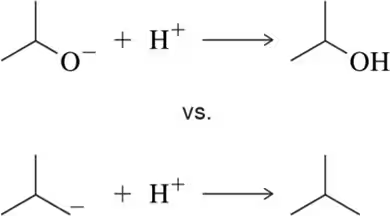
For each pair of reactions, predict which will happen more quickly.
[For (a) and (b), think about the stability of the bases involved.]
(a) Comparison of two chemical reactions involving bases and their stability, predicting reaction rates.

Guida verificata passo dopo passo
1
Step 1: Analyze the two reactions provided. In the first reaction, the base is an alkoxide ion (CH3CH2O⁻), which reacts with H⁺ to form an alcohol (CH3CH2OH). In the second reaction, the base is a carbanion (CH3CH2⁻), which reacts with H⁺ to form an alkane (CH3CH3).
Step 2: Consider the stability of the bases involved. Alkoxide ions (CH3CH2O⁻) are more stable than carbanions (CH3CH2⁻) because the negative charge on the oxygen atom is better stabilized due to its higher electronegativity compared to carbon.
Step 3: Recall that the stability of the base affects the rate of protonation. A more stable base will react more quickly with H⁺ because it is less reactive and more likely to accept a proton.
Step 4: Compare the two reactions. Since the alkoxide ion (CH3CH2O⁻) is more stable than the carbanion (CH3CH2⁻), the reaction involving the alkoxide ion will happen more quickly.
Step 5: Conclude that the first reaction (CH3CH2O⁻ + H⁺ → CH3CH2OH) will occur faster than the second reaction (CH3CH2⁻ + H⁺ → CH3CH3) due to the greater stability of the alkoxide ion compared to the carbanion.

Risposta video verificata per un problema simile:

Questa soluzione video è stata consigliata dai nostri tutor come utile per risolvere questo problema.
Durata del video:
3m

Concetti chiave

Ecco i concetti essenziali che devi comprendere per rispondere correttamente alla domanda.

Stability of Bases

The stability of a base is crucial in determining the rate of a reaction. A more stable base is less reactive and will typically lead to a slower reaction rate. Conversely, an unstable base is more reactive and can facilitate faster reactions. Understanding the factors that contribute to base stability, such as resonance and electronegativity, is essential for predicting reaction kinetics.
Video consigliato:
03:43
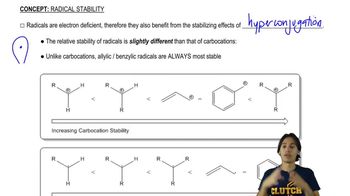
The radical stability trend.

Reaction Mechanism

The reaction mechanism outlines the step-by-step process by which reactants are converted into products. It includes the formation and breaking of bonds, the transition states, and the intermediates involved. Analyzing the mechanism helps in understanding which reactions are favored based on the stability of the intermediates and transition states, thus influencing the overall reaction rate.
Video consigliato:
02:16
Heck Reaction Mechanism

Kinetics and Thermodynamics

Kinetics refers to the study of the rates of chemical reactions, while thermodynamics deals with the energy changes associated with reactions. A reaction may be thermodynamically favorable but kinetically slow if it has a high activation energy barrier. Understanding both concepts is vital for predicting which reaction will occur more quickly, as they provide insight into the energy landscape and the speed of the reaction pathway.
Video consigliato:
08:51
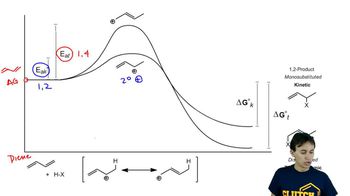
Kinetic vs. Thermodynamic Control