Ch. 5 - Chemical Reaction Analysis: Thermodynamics and Kinetics
Mullins - Organic Chemistry: A Learner Centered Approach 1st Edition
Mullins1st EditionOrganic Chemistry: A Learner Centered ApproachISBN: 9780137566471Non è quello che usi tu?Cambia libro di testo
Capitolo 4, Problema 38d

Using bond-dissociation energies, identify the most stable radical. Justify the difference in stability based on the structure.
(d) I• vs •OH

Guida verificata passo dopo passo
1
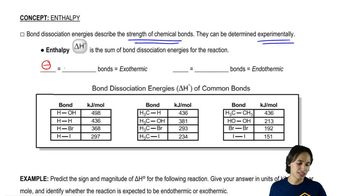
Identify the bond-dissociation energy (BDE) values for the bonds that would form the radicals I• and •OH. Bond-dissociation energy is the energy required to break a bond homolytically, resulting in two radicals. Look up the BDE for H-I and H-OH bonds in a reliable data source.
Compare the BDE values. A lower BDE indicates that the bond is easier to break, which often correlates with the stability of the resulting radical. This is because a more stable radical requires less energy to form.
Analyze the electronic structure of the radicals. I• is a halogen radical, and its stability is influenced by the large size of the iodine atom, which allows the unpaired electron to be delocalized over a larger volume, reducing electron-electron repulsion. In contrast, •OH is a smaller radical with a highly electronegative oxygen atom, which holds the unpaired electron tightly, making it less stable.
Consider the periodic trends. Iodine is in the same group as other halogens but is much larger and less electronegative than oxygen. This makes I• more stable because the unpaired electron experiences less repulsion and is less tightly held compared to •OH.
Conclude that I• is the more stable radical based on its lower bond-dissociation energy and the ability of iodine to better stabilize the unpaired electron due to its size and lower electronegativity compared to oxygen.

Risposta video verificata per un problema simile:

Questa soluzione video è stata consigliata dai nostri tutor come utile per risolvere questo problema.

Concetti chiave

Ecco i concetti essenziali che devi comprendere per rispondere correttamente alla domanda.

Bond-Dissociation Energy

Bond-dissociation energy (BDE) is the energy required to break a bond in a molecule, resulting in the formation of radicals. Higher BDE values indicate stronger bonds, which correlate with lower radical stability. Understanding BDE is crucial for comparing the stability of different radicals, as it helps predict which radical is more likely to form based on the energy required to dissociate the bond.
Video consigliato:
04:09
How to calculate enthalpy using bond dissociation energies.

Radical Stability

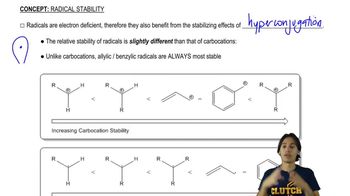
Radical stability refers to the relative stability of radical species, which are molecules with unpaired electrons. Factors influencing radical stability include the degree of substitution (primary, secondary, tertiary), resonance effects, and electronegativity of adjacent atoms. More substituted radicals or those that can delocalize their unpaired electron through resonance are generally more stable.
Video consigliato:
03:43
The radical stability trend.

Structure-Activity Relationship

Structure-activity relationship (SAR) is a principle that relates the chemical structure of a compound to its biological activity or stability. In the context of radicals, the arrangement of atoms and the presence of functional groups can significantly affect radical stability. Analyzing the structural differences between radicals like I• and •OH helps explain their varying stabilities based on steric and electronic factors.
Video consigliato:
Percorso guidato
4:47
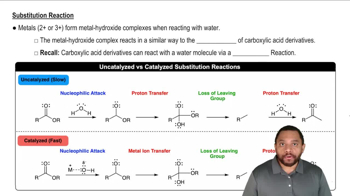
Metal Ion Catalysis: Water Activation Concept 2