Ch. 5 - Chemical Reaction Analysis: Thermodynamics and Kinetics
Mullins - Organic Chemistry: A Learner Centered Approach 1st Edition
Mullins1st EditionOrganic Chemistry: A Learner Centered ApproachISBN: 9780137566471Non è quello che usi tu?Cambia libro di testo
Capitolo 4, Problema 26b

Within the following pairs, pick which reaction you would expect to be faster based on having a higher value of the frequency factor (A).
(b)

Guida verificata passo dopo passo
1
Step 1: Analyze the two reactions provided in the image. The first reaction involves a nucleophilic attack on a ketone (acetone derivative), while the second reaction involves a nucleophilic attack on an alcohol (isopropanol derivative).
Step 2: Recall that the frequency factor (A) in the Arrhenius equation is influenced by the steric accessibility of the reactive site and the orientation of the molecules during the collision. Reactions with less steric hindrance and better molecular alignment tend to have higher frequency factors.
Step 3: Compare the steric hindrance in the two reactions. In the ketone reaction, the carbonyl group is planar and more accessible to nucleophilic attack. In contrast, the alcohol reaction involves a hydroxyl group, which is less planar and has hydrogen bonding that can hinder the approach of the nucleophile.
Step 4: Consider the electronic effects. The carbonyl group in the ketone is highly polarized, making the carbon atom more electrophilic and more likely to attract the nucleophile. The hydroxyl group in the alcohol is less polarized, making the reaction slower.
Step 5: Based on steric and electronic considerations, the reaction involving the ketone is expected to have a higher frequency factor (A) and thus proceed faster compared to the reaction involving the alcohol.

Risposta video verificata per un problema simile:

Questa soluzione video è stata consigliata dai nostri tutor come utile per risolvere questo problema.

Concetti chiave

Ecco i concetti essenziali che devi comprendere per rispondere correttamente alla domanda.

Frequency Factor (A)

The frequency factor, often denoted as A in the Arrhenius equation, represents the number of times reactants collide with the correct orientation to form products. A higher frequency factor indicates more effective collisions, which can lead to a faster reaction rate. It is influenced by factors such as molecular orientation and the concentration of reactants.
Video consigliato:
16:47
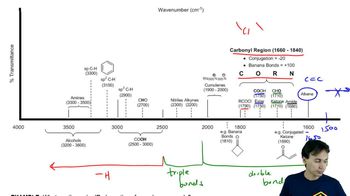
Common IR Frequencies

Arrhenius Equation

The Arrhenius equation describes the temperature dependence of reaction rates and is given by k = A * e^(-Ea/RT), where k is the rate constant, Ea is the activation energy, R is the gas constant, and T is the temperature in Kelvin. Understanding this equation helps in analyzing how changes in temperature and the frequency factor affect the speed of chemical reactions.
Video consigliato:
05:02
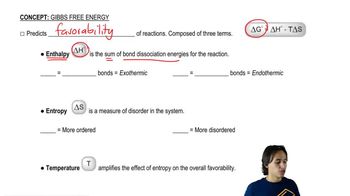
Breaking down the different terms of the Gibbs Free Energy equation.

Reaction Mechanism

A reaction mechanism outlines the step-by-step sequence of elementary reactions that lead to the overall reaction. Each step has its own rate, influenced by factors like the frequency factor and activation energy. Analyzing the mechanism can help predict which reaction will proceed faster based on the characteristics of the involved species.
Video consigliato:
02:16
Heck Reaction Mechanism