Ch. 8 - Alkenes 1: Properties and Electrophilic Additions
Mullins - Organic Chemistry: A Learner Centered Approach 1st Edition
Mullins1st EditionOrganic Chemistry: A Learner Centered ApproachISBN: 9780137566471Non è quello che usi tu?Cambia libro di testo
Capitolo 7, Problema 66c

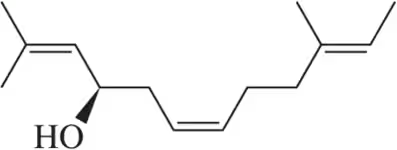
How many stereoisomers are possible for the following alkenes?
(c) Chemical structure of an alkene with a hydroxyl group, illustrating stereoisomer possibilities.

Guida verificata passo dopo passo
1
Step 1: Identify the stereogenic centers in the molecule. A stereogenic center is an atom (usually carbon) bonded to four different groups. In the given structure, the carbon attached to the hydroxyl group (-OH) is a stereogenic center because it is bonded to four distinct groups.
Step 2: Determine the number of double bonds in the molecule that can exhibit cis-trans (E/Z) isomerism. Double bonds can show stereoisomerism if each carbon in the double bond is attached to two different groups. In the given structure, there are two double bonds that can exhibit E/Z isomerism.
Step 3: Calculate the total number of stereoisomers using the formula: Total stereoisomers = 2^n, where n is the number of stereogenic centers and stereoisomeric double bonds. In this case, there is 1 stereogenic center and 2 stereoisomeric double bonds, so n = 3.
Step 4: Apply the formula to calculate the total number of stereoisomers. Since n = 3, the total number of stereoisomers is 2^3 = 8.
Step 5: Verify the structure to ensure no additional stereogenic centers or stereoisomeric double bonds are overlooked. Confirm that the molecule has 1 stereogenic center and 2 stereoisomeric double bonds, leading to 8 possible stereoisomers.

Risposta video verificata per un problema simile:

Questa soluzione video è stata consigliata dai nostri tutor come utile per risolvere questo problema.
Durata del video:
1m

Concetti chiave

Ecco i concetti essenziali che devi comprendere per rispondere correttamente alla domanda.

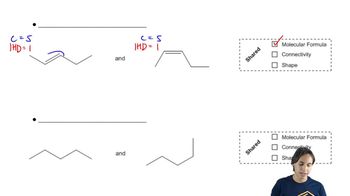
Stereoisomerism

Stereoisomerism refers to the phenomenon where compounds have the same molecular formula and connectivity of atoms but differ in the spatial arrangement of their atoms. This can lead to different physical and chemical properties. In alkenes, stereoisomers arise due to the restricted rotation around the double bond, resulting in cis and trans configurations.
Video consigliato:
01:58
Determining when molecules are stereoisomers.

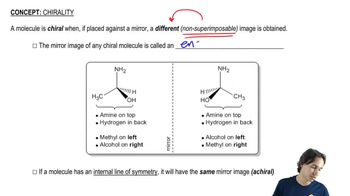
Chirality

Chirality is a property of a molecule that makes it non-superimposable on its mirror image, often due to the presence of a chiral center, typically a carbon atom bonded to four different substituents. In the context of alkenes, if a double bond is attached to two different groups on each carbon, it can lead to the formation of enantiomers, which are a type of stereoisomer.
Video consigliato:
05:10
What is chirality?

Counting Stereoisomers

The number of possible stereoisomers for a compound can be determined using the formula 2^n, where n is the number of chiral centers in the molecule. Additionally, for alkenes with restricted rotation, the presence of different substituents on the double bond can also contribute to the total count of stereoisomers, including both geometric (cis/trans) and optical isomers.
Video consigliato:
07:07
Electron Counting