
Ch. 8 - Alkenes 1: Properties and Electrophilic Additions
Mullins - Organic Chemistry: A Learner Centered Approach 1st Edition
Mullins1st EditionOrganic Chemistry: A Learner Centered ApproachISBN: 9780137566471Non è quello che usi tu?Cambia libro di testo
Capitolo 7, Problema 70

If you react carvone with a single equivalent of HBr, only one product is produced, even though carvone has two carbon–carbon double bonds. Explain this observation.
Carvone reacts with HBr to form a single brominated product, despite having two double bonds.

Guida verificata passo dopo passo
1
Carvone is a terpenoid with two carbon-carbon double bonds, one in the ring and one in the side chain. The reactivity of these double bonds can differ based on their location and the surrounding chemical environment.
When HBr is added to carvone, it acts as an electrophile due to the polarization of the H-Br bond, where H is partially positive and Br is partially negative.
The double bond in the ring is more substituted compared to the double bond in the side chain. According to Markovnikov's rule, the more substituted double bond is more likely to react with HBr because it can form a more stable carbocation intermediate.
The reaction proceeds with the addition of HBr across the more substituted double bond, leading to the formation of a carbocation at the more stable position. This carbocation is then attacked by the bromide ion (Br⁻) to form the final product.
The less substituted double bond does not react under these conditions because the formation of a carbocation at this position would be less stable. Therefore, only one product is formed from the reaction of carvone with a single equivalent of HBr.

Risposta video verificata per un problema simile:

Questa soluzione video è stata consigliata dai nostri tutor come utile per risolvere questo problema.
Durata del video:
2m

Concetti chiave

Ecco i concetti essenziali che devi comprendere per rispondere correttamente alla domanda.

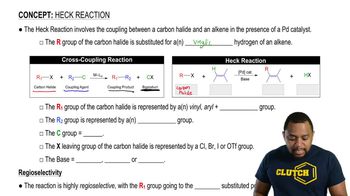
Regioselectivity

Regioselectivity refers to the preference of a chemical reaction to occur at one direction or position over others in a molecule. In the case of carvone reacting with HBr, the reaction is regioselective, favoring one double bond over the other due to factors like steric hindrance or electronic effects, leading to a single product.
Video consigliato:
05:09
Heck Reaction

Markovnikov's Rule

Markovnikov's Rule predicts the outcome of the addition of HX (where X is a halogen) to alkenes, stating that the hydrogen atom will attach to the carbon with more hydrogen substituents, while the halogen will attach to the carbon with fewer hydrogen substituents. This rule helps explain why only one product is formed when HBr is added to carvone.
Video consigliato:
03:54
The 18 and 16 Electron Rule

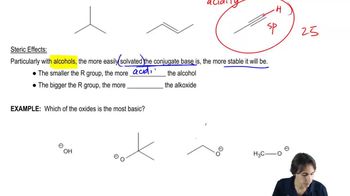
Steric Hindrance

Steric hindrance occurs when the size of groups within a molecule prevents chemical reactions at certain sites. In carvone, one of the double bonds may be less accessible due to bulky groups nearby, making it less reactive to HBr. This steric effect can lead to the selective reaction at the more accessible double bond, resulting in a single product.
Video consigliato:
02:53
Understanding steric effects.
Pratica correlata
Domanda del libro di testo

When using sulfuric acid, but in the absence of other nucleophiles like water or bromide ion, less stable alkenes can be isomerized to their more stable isomer. Provide a mechanism for these acid-catalyzed isomerization reactions. [This is one illustration of the principle of microscopic reversibility.]

(b)

795
views
Domanda del libro di testo

Predict the product of each of the following hydroboration–oxidation or oxymercuration–reduction reactions used in the modern synthetic organic chemistry literature (modified to use reagents we are used to seeing).

(b) A two-step hydroboration–oxidation was used to prepare a silanediol peptidomimetic as a serine protease inhibitor (Org. Lett. 2012, 14, 4422–4425).

1022
views
Domanda del libro di testo

A common situation occurs when both carbons of the mercurinium ion are secondary. In a situation like the one shown, to which carbon would you expect water to add? That is, would you expect to produce A or B? Explain your answer.

1119
views
Domanda del libro di testo

When using sulfuric acid, but in the absence of other nucleophiles like water or bromide ion, less stable alkenes can be isomerized to their more stable isomer. Provide a mechanism for these acid-catalyzed isomerization reactions. [This is one illustration of the principle of microscopic reversibility.]

(c)

106
views
Domanda del libro di testo

Predict the product of each of the following hydroboration–oxidation or oxymercuration–reduction reactions used in the modern synthetic organic chemistry literature (modified to use reagents we are used to seeing).

(c) A similar sequence was featured in the synthesis of muricadienin, a proposed precursor in the biosynthesis of solamin (Org. Lett. 2014, 16, 5886–5889).

834
views
Domanda del libro di testo

When using sulfuric acid, but in the absence of other nucleophiles like water or bromide ion, less stable alkenes can be isomerized to their more stable isomer. Provide a mechanism for these acid-catalyzed isomerization reactions. [This is one illustration of the principle of microscopic reversibility.]

(a)

1125
views