

Ch. 8 - Alkenes 1: Properties and Electrophilic Additions
Mullins - Organic Chemistry: A Learner Centered Approach 1st Edition
Mullins1st EditionOrganic Chemistry: A Learner Centered ApproachISBN: 9780137566471Non è quello che usi tu?Cambia libro di testo
Capitolo 7, Problema 79f

In addition to radicals, anions, and cations, a fourth class of reactive intermediates is carbenes. A neutral species, the simplest carbene has a molecular formula of CH2.
(f) Cyclopropanation of (E)- and (Z)-3-methylhex-3-ene gives two different products. Rationalize this outcome.

Guida verificata passo dopo passo
1
Step 1: Understand the concept of carbenes. Carbenes are neutral reactive intermediates with a divalent carbon atom that has two nonbonded electrons. The simplest carbene is methylene (CH₂), which can react with alkenes to form cyclopropane rings through a process called cyclopropanation.
Step 2: Analyze the structures of (E)- and (Z)-3-methylhex-3-ene. The (E)-isomer has the substituents on opposite sides of the double bond, while the (Z)-isomer has the substituents on the same side. This stereochemistry affects the spatial arrangement of the substituents during the reaction.
Step 3: Examine the reaction mechanism. The carbene (CH₂) reacts with the double bond of the alkene to form a cyclopropane ring. The stereochemistry of the starting alkene determines the stereochemistry of the cyclopropane products.
Step 4: Rationalize the formation of two different products for each isomer. For the (E)-isomer, the substituents on opposite sides of the double bond lead to two distinct stereoisomers of the cyclopropane product due to the approach of the carbene from either side of the double bond. Similarly, for the (Z)-isomer, the substituents on the same side of the double bond result in two stereoisomers of the cyclopropane product.
Step 5: Conclude that the stereochemistry of the starting alkene dictates the stereochemistry of the cyclopropane products. The reaction preserves the relative spatial arrangement of the substituents, leading to stereoisomeric products for both (E)- and (Z)-3-methylhex-3-ene.

Risposta video verificata per un problema simile:

Questa soluzione video è stata consigliata dai nostri tutor come utile per risolvere questo problema.
Durata del video:
8m

Concetti chiave

Ecco i concetti essenziali che devi comprendere per rispondere correttamente alla domanda.

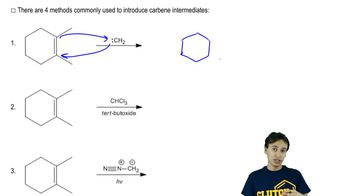
Carbenes

Carbenes are neutral reactive intermediates characterized by a carbon atom with only six valence electrons, making them highly reactive. The simplest carbene, methylene (CH₂), can participate in various reactions, including cyclopropanation, where it adds across double bonds to form three-membered rings. Understanding carbenes is crucial for predicting the outcomes of reactions involving alkenes.
Video consigliato:
01:48
Reaction with a simple carbene.

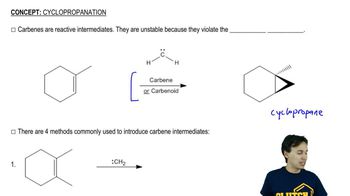
Cyclopropanation

Cyclopropanation is a chemical reaction that involves the addition of a carbene to an alkene, resulting in the formation of a cyclopropane ring. This reaction can lead to different stereochemical outcomes depending on the geometry of the starting alkene (E or Z isomers). The stereochemistry of the alkene influences the orientation of the carbene attack, which is essential for rationalizing the formation of distinct products.
Video consigliato:
01:49
General properties of cyclopropanation.

Stereochemistry

Stereochemistry refers to the study of the spatial arrangement of atoms in molecules and how this affects their chemical behavior. In the context of (E)- and (Z)-3-methylhex-3-ene, the different spatial arrangements lead to different reactivity patterns when reacting with carbenes. Recognizing the stereochemical differences is vital for understanding why cyclopropanation yields different products from these isomers.
Video consigliato:
Percorso guidato
1:38
Polymer Stereochemistry Concept 1