
Ch. 8 - Alkenes 1: Properties and Electrophilic Additions
Mullins - Organic Chemistry: A Learner Centered Approach 1st Edition
Mullins1st EditionOrganic Chemistry: A Learner Centered ApproachISBN: 9780137566471Non è quello che usi tu?Cambia libro di testo
Capitolo 7, Problema 79b

In addition to radicals, anions, and cations, a fourth class of reactive intermediates is carbenes. A neutral species, the simplest carbene has a molecular formula of CH2.
(b) What are the hybridization and shape of the central carbon of CH2?

Guida verificata passo dopo passo
1
Step 1: Understand the concept of carbenes. Carbenes are neutral species with a divalent carbon atom that has only six valence electrons, making them highly reactive intermediates. The simplest carbene is CH₂, which consists of a carbon atom bonded to two hydrogen atoms and has two non-bonding electrons.
Step 2: Analyze the electronic configuration of the central carbon atom in CH₂. The carbon atom has four valence electrons. In CH₂, two electrons are used to form sigma bonds with the hydrogen atoms, leaving two non-bonding electrons on the carbon.
Step 3: Determine the hybridization of the central carbon atom. Since the carbon atom forms two sigma bonds and has two non-bonding electrons, it uses sp² hybrid orbitals for bonding. The two sp² orbitals form sigma bonds with the hydrogen atoms, while the remaining p orbital contains the non-bonding electrons.
Step 4: Identify the shape of the molecule. The sp² hybridization results in a trigonal planar arrangement of the orbitals around the carbon atom. However, due to the presence of the lone pair of electrons, the actual shape of CH₂ is bent (angular).
Step 5: Summarize the findings. The central carbon atom in CH₂ is sp² hybridized, and the molecular shape is bent due to the lone pair of electrons on the carbon atom.

Risposta video verificata per un problema simile:

Questa soluzione video è stata consigliata dai nostri tutor come utile per risolvere questo problema.
Durata del video:
2m

Concetti chiave

Ecco i concetti essenziali che devi comprendere per rispondere correttamente alla domanda.

Hybridization

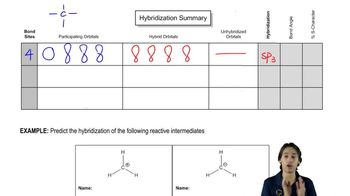
Hybridization is the concept of mixing atomic orbitals to form new hybrid orbitals that can accommodate bonding. In the case of CH₂, the central carbon atom undergoes sp² hybridization, where one s orbital and two p orbitals combine to create three equivalent sp² hybrid orbitals, allowing for the formation of sigma bonds with adjacent atoms.
Video consigliato:
10:43
Using bond sites to predict hybridization

Molecular Geometry

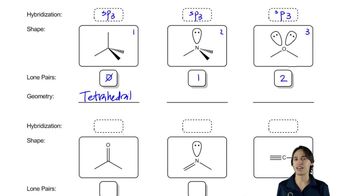
Molecular geometry refers to the three-dimensional arrangement of atoms in a molecule. For CH₂, the sp² hybridization leads to a trigonal planar geometry around the central carbon atom, with bond angles of approximately 120 degrees. This shape is crucial for understanding the reactivity and properties of carbenes.
Video consigliato:
07:44
Molecular Geometry Explained.

Reactive Intermediates

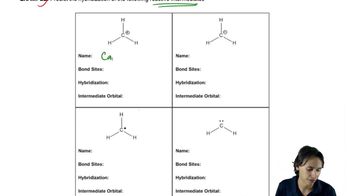
Reactive intermediates are transient species that form during the course of a chemical reaction and are often highly reactive. Carbenes, such as CH₂, are a class of reactive intermediates characterized by a neutral carbon atom with only six valence electrons, making them highly reactive and capable of participating in various chemical reactions, including addition and insertion reactions.
Video consigliato:
02:47
Introduction to the reactive intermediates.
Pratica correlata
Domanda del libro di testo

In addition to radicals, anions, and cations, a fourth class of reactive intermediates is carbenes. A neutral species, the simplest carbene has a molecular formula of CH2.

(h) Of the reactions studied here in Chapter 8, cyclopropanation is most similar to which?

956
views
Domanda del libro di testo

In addition to radicals, anions, and cations, a fourth class of reactive intermediates is carbenes. A neutral species, the simplest carbene has a molecular formula of CH2 .

(e) Carbenes have great synthetic utility, especially in the synthesis of cyclopropanes from alkenes. Based on your answers to (a)–(d), show a mechanism for the cyclopropanation of cyclohexene.

1250
views
Domanda del libro di testo

The reaction of (E)-3-chlorohex-3-ene with HCl results in the selective formation of 3,3-dichlorohexane instead of 3,4-dichlorohexane. Explain this result.

1572
views
Domanda del libro di testo

In addition to radicals, anions, and cations, a fourth class of reactive intermediates is carbenes. A neutral species, the simplest carbene has a molecular formula of CH2.

(a) Draw the Lewis structure of CH2.

1172
views
Domanda del libro di testo

In addition to radicals, anions, and cations, a fourth class of reactive intermediates is carbenes. A neutral species, the simplest carbene has a molecular formula of CH2.

(f) Cyclopropanation of (E)- and (Z)-3-methylhex-3-ene gives two different products. Rationalize this outcome.

978
views
Domanda del libro di testo

The acid-catalyzed hydration we learned here in Chapter 8 is reversible:

(e) How might you shift the equilibrium to the left?

1206
views