Ch. 8 - Alkenes 1: Properties and Electrophilic Additions
Mullins - Organic Chemistry: A Learner Centered Approach 1st Edition
Mullins1st EditionOrganic Chemistry: A Learner Centered ApproachISBN: 9780137566471Non è quello che usi tu?Cambia libro di testo
Capitolo 7, Problema 61g(vi)

Predict the product(s) that would result when the alkenes shown here are allowed to react under the following conditions: (vi) 1. BH3 2. H2O2, NaOH
(g) Structural representation of alkenes for hydrohalogenation reaction with HBr.

Guida verificata passo dopo passo
1
Identify the reaction type: The given reagents (1. BH₃, 2. H₂O₂, NaOH) indicate a hydroboration-oxidation reaction. This reaction is used to convert an alkene into an alcohol.
Understand the regioselectivity: Hydroboration-oxidation follows anti-Markovnikov addition, meaning the hydroxyl group (-OH) will attach to the less substituted carbon of the double bond.
Understand the stereochemistry: The addition of BH₃ occurs in a syn fashion, meaning both the boron and hydrogen add to the same side of the alkene. This stereochemistry is retained during the oxidation step, resulting in a syn addition of the hydroxyl group and hydrogen.
Apply the reaction to the given alkene: Identify the double bond in the alkene structure and determine which carbon is less substituted. Attach the hydroxyl group (-OH) to the less substituted carbon and a hydrogen atom to the more substituted carbon.
Draw the product: After determining the regioselectivity and stereochemistry, draw the final product, ensuring the hydroxyl group is on the less substituted carbon and the stereochemistry reflects syn addition.

Risposta video verificata per un problema simile:

Questa soluzione video è stata consigliata dai nostri tutor come utile per risolvere questo problema.
Durata del video:
3m

Concetti chiave

Ecco i concetti essenziali che devi comprendere per rispondere correttamente alla domanda.

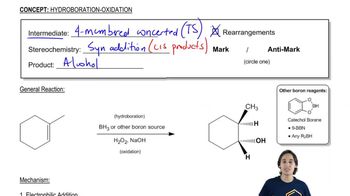
Hydroboration-Oxidation

Hydroboration-oxidation is a two-step reaction process used to convert alkenes into alcohols. In the first step, borane (BH₃) adds across the double bond of the alkene, resulting in a trialkylborane intermediate. The second step involves oxidation with hydrogen peroxide (H₂O₂) in the presence of a base (NaOH), which converts the boron atom into a hydroxyl group, yielding an alcohol.
Video consigliato:
06:38
General properties of hydroboration-oxidation.

Regioselectivity

Regioselectivity refers to the preference of a chemical reaction to yield one structural isomer over others when multiple products are possible. In hydroboration, the addition of borane occurs in a syn manner, favoring the formation of the less substituted alcohol due to the anti-Markovnikov rule, where the hydroxyl group ends up on the less substituted carbon of the alkene.
Video consigliato:
05:09
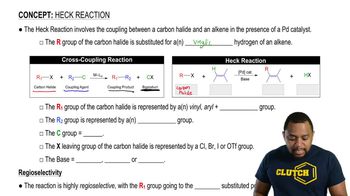
Heck Reaction

Stereochemistry

Stereochemistry is the study of the spatial arrangement of atoms in molecules and how this affects their chemical behavior. In the hydroboration-oxidation process, the syn addition of BH₃ leads to specific stereochemical outcomes in the final alcohol product, which can influence the reactivity and properties of the resulting compound.
Video consigliato:
Percorso guidato
1:38
Polymer Stereochemistry Concept 1