Ch. 8 - Alkenes 1: Properties and Electrophilic Additions
Mullins - Organic Chemistry: A Learner Centered Approach 1st Edition
Mullins1st EditionOrganic Chemistry: A Learner Centered ApproachISBN: 9780137566471Non è quello che usi tu?Cambia libro di testo
Capitolo 7, Problema 61g(i)

Predict the product(s) that would result when the alkenes shown here are allowed to react under the following conditions: (i) HBr
(g) Structural representation of alkenes for hydrohalogenation reaction with HBr.

Guida verificata passo dopo passo
1
Identify the type of reaction: The reaction involves an alkene and HBr, which is an example of an electrophilic addition reaction. This reaction follows Markovnikov's rule, where the hydrogen atom from HBr adds to the carbon of the double bond with the greater number of hydrogen atoms, and the bromine atom adds to the other carbon.
Analyze the structure of the alkene: Determine the position of the double bond in the alkene and identify the two carbons involved in the π-bond. Label these carbons as C1 and C2 for clarity.
Apply Markovnikov's rule: The hydrogen atom from HBr will add to the carbon (C1) of the double bond that already has more hydrogen atoms, while the bromine atom will add to the carbon (C2) with fewer hydrogen atoms.
Consider carbocation stability: If the addition of H⁺ to the alkene creates a carbocation intermediate, evaluate whether a rearrangement (e.g., hydride or alkyl shift) might occur to form a more stable carbocation before the bromine adds.
Draw the product(s): Based on the above steps, draw the final product(s) of the reaction. If the alkene is symmetrical, a single product will form. If the alkene is asymmetrical, consider whether regioisomers or stereoisomers might result.

Risposta video verificata per un problema simile:

Questa soluzione video è stata consigliata dai nostri tutor come utile per risolvere questo problema.
Durata del video:
3m

Concetti chiave

Ecco i concetti essenziali che devi comprendere per rispondere correttamente alla domanda.

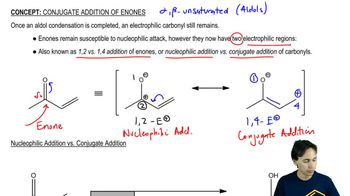
Electrophilic Addition

Electrophilic addition is a fundamental reaction mechanism in organic chemistry where an electrophile reacts with a nucleophile, typically involving alkenes. In the case of alkenes reacting with HBr, the double bond acts as a nucleophile, attacking the electrophilic hydrogen atom, leading to the formation of a carbocation intermediate. This process is crucial for predicting the products of reactions involving alkenes.
Video consigliato:
09:23
1,2 vs 1,4 Addition

Markovnikov's Rule

Markovnikov's Rule states that in the addition of HX (where X is a halogen) to an alkene, the hydrogen atom will attach to the carbon with the greater number of hydrogen atoms already attached. This rule helps predict the regioselectivity of the reaction, guiding the formation of the more stable carbocation and ultimately influencing the major product formed during the reaction with HBr.
Video consigliato:
03:54
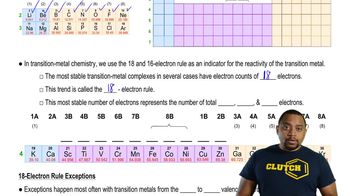
The 18 and 16 Electron Rule

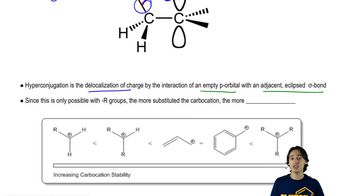
Carbocation Stability

Carbocation stability is a key concept in organic chemistry that refers to the relative stability of positively charged carbon species. Carbocations are classified as primary, secondary, or tertiary based on the number of alkyl groups attached to the positively charged carbon. Tertiary carbocations are the most stable due to hyperconjugation and inductive effects, which play a significant role in determining the product distribution in reactions involving alkenes and electrophiles like HBr.
Video consigliato:
05:58
Determining Carbocation Stability