Ch. 8 - Alkenes 1: Properties and Electrophilic Additions
Mullins - Organic Chemistry: A Learner Centered Approach 1st Edition
Mullins1st EditionOrganic Chemistry: A Learner Centered ApproachISBN: 9780137566471Non è quello che usi tu?Cambia libro di testo
Capitolo 7, Problema 61b(iv)

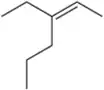
Predict the product(s) that would result when the alkenes shown here are allowed to react under the following conditions: (iv) H2SO4 , H2O
(b) Structural representation of alkenes for predicting products of acid-catalyzed hydration reactions.

Guida verificata passo dopo passo
1
Step 1: Identify the type of reaction. The given reagents, H₂SO₄ (sulfuric acid) and H₂O (water), indicate an acid-catalyzed hydration reaction. This reaction typically adds a hydroxyl group (-OH) to the alkene, converting it into an alcohol.
Step 2: Determine the regioselectivity of the reaction. Acid-catalyzed hydration follows Markovnikov's rule, meaning the -OH group will add to the more substituted carbon of the double bond, while the hydrogen (H) will add to the less substituted carbon.
Step 3: Analyze the structure of the alkene. Locate the double bond in the molecule and identify the two carbons involved in the double bond. Determine which carbon is more substituted (has more alkyl groups attached) and which is less substituted.
Step 4: Consider carbocation stability. During the reaction mechanism, a carbocation intermediate is formed. The reaction will favor the formation of the most stable carbocation (tertiary > secondary > primary). If necessary, rearrangements may occur to achieve a more stable carbocation.
Step 5: Write the product structure. After the addition of H and -OH groups according to Markovnikov's rule, draw the final product, ensuring the hydroxyl group is attached to the more substituted carbon and the hydrogen is attached to the less substituted carbon.

Risposta video verificata per un problema simile:

Questa soluzione video è stata consigliata dai nostri tutor come utile per risolvere questo problema.
Durata del video:
1m

Concetti chiave

Ecco i concetti essenziali che devi comprendere per rispondere correttamente alla domanda.

Electrophilic Addition

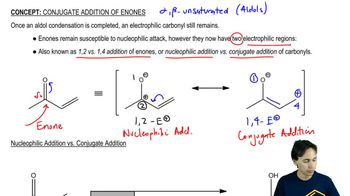
Electrophilic addition is a fundamental reaction mechanism in organic chemistry where an electrophile reacts with a nucleophile, typically involving alkenes. In the presence of strong acids like H₂SO₄, the alkene's double bond acts as a nucleophile, attacking the electrophilic hydrogen, leading to the formation of a carbocation intermediate. This step is crucial for predicting the products of reactions involving alkenes.
Video consigliato:
09:23
1,2 vs 1,4 Addition

Carbocation Stability

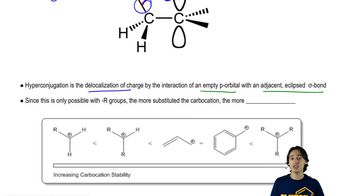
Carbocation stability is a key concept in organic reactions, as the stability of the carbocation intermediate influences the reaction pathway and product distribution. Carbocations can be classified as primary, secondary, or tertiary, with tertiary carbocations being the most stable due to hyperconjugation and inductive effects. Understanding the stability of these intermediates helps predict the major products formed during electrophilic addition reactions.
Video consigliato:
05:58
Determining Carbocation Stability

Hydration Reaction

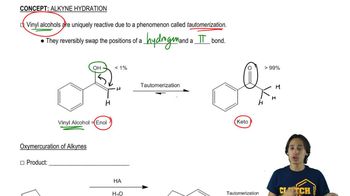
The hydration reaction involves the addition of water (H₂O) to an alkene, typically facilitated by an acid catalyst like H₂SO₄. This reaction results in the formation of alcohols, where the hydroxyl group (-OH) is added to the more substituted carbon of the alkene, following Markovnikov's rule. Recognizing this principle is essential for predicting the final products when alkenes react with acids and water.
Video consigliato:
09:11
Alkyne Hydration