Ch. 8 - Alkenes 1: Properties and Electrophilic Additions
Mullins - Organic Chemistry: A Learner Centered Approach 1st Edition
Mullins1st EditionOrganic Chemistry: A Learner Centered ApproachISBN: 9780137566471Non è quello che usi tu?Cambia libro di testo
Capitolo 7, Problema 61b(iii)

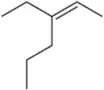
Predict the product(s) that would result when the alkenes shown here are allowed to react under the following conditions: (iii) HBr, H2O2
(b) Structural representation of alkenes for predicting products of anti-Markovnikov addition of HBr with H2O2.

Guida verificata passo dopo passo
1
Identify the type of reaction: The reaction involves an alkene reacting with HBr in the presence of H₂O₂. This is a free-radical addition reaction, which follows the anti-Markovnikov rule due to the presence of H₂O₂ (peroxide).
Understand the anti-Markovnikov rule: In the presence of peroxides, the bromine atom (Br) will add to the less substituted carbon of the double bond, while the hydrogen atom (H) will add to the more substituted carbon. This is the opposite of the Markovnikov rule.
Initiate the reaction mechanism: The reaction begins with the homolytic cleavage of the peroxide bond (ROOR) to generate two alkoxy radicals. These radicals then react with HBr to form a bromine radical (Br•).
Propagate the reaction: The bromine radical (Br•) reacts with the alkene, breaking the π-bond and forming a new carbon-bromine bond at the less substituted carbon. This generates a carbon-centered radical on the more substituted carbon.
Complete the reaction: The carbon-centered radical reacts with another molecule of HBr, abstracting a hydrogen atom to form the final product. The product will have the bromine atom attached to the less substituted carbon of the original double bond, consistent with the anti-Markovnikov addition.

Risposta video verificata per un problema simile:

Questa soluzione video è stata consigliata dai nostri tutor come utile per risolvere questo problema.

Concetti chiave

Ecco i concetti essenziali che devi comprendere per rispondere correttamente alla domanda.

Electrophilic Addition

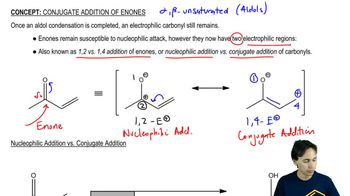
Electrophilic addition is a fundamental reaction mechanism in organic chemistry where an electrophile reacts with a nucleophile, typically involving alkenes. In the presence of HBr, the double bond of the alkene acts as a nucleophile, attacking the electrophilic hydrogen atom, leading to the formation of a carbocation intermediate. This process is crucial for predicting the products of reactions involving alkenes.
Video consigliato:
09:23
1,2 vs 1,4 Addition

Anti-Markovnikov's Rule

Anti-Markovnikov's Rule states that in the addition of HX to alkenes, the hydrogen atom will add to the less substituted carbon atom of the double bond when a peroxide (like H₂O₂) is present. This contrasts with Markovnikov's Rule, where the hydrogen would add to the more substituted carbon. Understanding this rule is essential for predicting the correct product distribution in reactions involving HBr and peroxides.
Video consigliato:
03:19
The Anti-Coplanar Requirement

Radical Mechanism

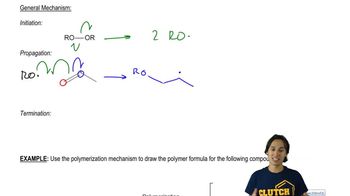
The radical mechanism involves the formation of free radicals during a chemical reaction, which can lead to different product outcomes compared to ionic mechanisms. In the presence of H₂O₂, the reaction proceeds via a radical pathway, generating bromine radicals that add to the alkene. This mechanism is key to understanding how the presence of peroxides alters the typical electrophilic addition reactions of alkenes.
Video consigliato:
03:28
The mechanism of Radical Polymerization.