Ch. 8 - Alkenes 1: Properties and Electrophilic Additions
Mullins - Organic Chemistry: A Learner Centered Approach 1st Edition
Mullins1st EditionOrganic Chemistry: A Learner Centered ApproachISBN: 9780137566471Non è quello che usi tu?Cambia libro di testo
Capitolo 7, Problema 59g

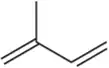
Using IUPAC rules, name the following molecules.
(g) Structural formula of a hydrocarbon with a double bond, illustrating the arrangement of carbon atoms and bonds.

Guida verificata passo dopo passo
1
Step 1: Identify the longest continuous carbon chain in the molecule. This chain will serve as the parent chain, and its length determines the base name (e.g., methane, ethane, propane, etc.).
Step 2: Number the parent chain starting from the end closest to the first substituent group. This ensures the substituents receive the lowest possible numbers.
Step 3: Identify and name all substituents attached to the parent chain. Substituents are groups like alkyl chains (e.g., methyl, ethyl) or functional groups (e.g., hydroxyl, halogens).
Step 4: Combine the names of the substituents with the parent chain name. Use prefixes to indicate the number of identical substituents (e.g., di-, tri-, tetra-) and place the substituent names in alphabetical order. Include the position numbers of the substituents before their names.
Step 5: If applicable, include stereochemical descriptors (e.g., cis-, trans-, R-, S-) to indicate the spatial arrangement of atoms or groups in the molecule. Ensure the final name follows IUPAC conventions.

Risposta video verificata per un problema simile:

Questa soluzione video è stata consigliata dai nostri tutor come utile per risolvere questo problema.
Durata del video:
5m

Concetti chiave

Ecco i concetti essenziali che devi comprendere per rispondere correttamente alla domanda.

IUPAC Nomenclature

IUPAC nomenclature is a systematic method for naming organic chemical compounds. It provides rules for identifying the structure of a molecule based on its functional groups, carbon chain length, and branching. Understanding these rules is essential for accurately naming compounds and communicating their structures in the scientific community.
Video consigliato:
03:43
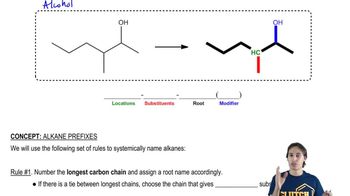
The different parts of an IUPAC name

Functional Groups

Functional groups are specific groups of atoms within molecules that are responsible for the characteristic chemical reactions of those molecules. Common functional groups include alcohols, carboxylic acids, and amines. Recognizing functional groups is crucial for determining the appropriate suffixes and prefixes in IUPAC names.
Video consigliato:
02:36
Identifying Functional Groups

Carbon Chain Structure

The carbon chain structure refers to the arrangement of carbon atoms in a molecule, which can be linear, branched, or cyclic. The length and branching of the carbon chain influence the naming conventions in IUPAC nomenclature, as longer chains and specific branching patterns dictate the base name and numbering of the compound.
Video consigliato:
04:25
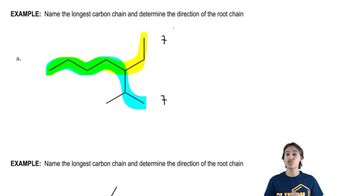
Name the longest carbon chain