Ch. 9 - Alkenes 2: Oxidation and Reduction
Mullins - Organic Chemistry: A Learner Centered Approach 1st Edition
Mullins1st EditionOrganic Chemistry: A Learner Centered ApproachISBN: 9780137566471Non è quello che usi tu?Cambia libro di testo
Capitolo 8, Problema 38a

Conjugated dienes, molecules containing two alkenes separated by one single bond, are discussed in detail in Chapter 21.
(a) Considering the observed ∆H° of hydrogenation, is hexa-1,3-diene (conjugated) or hexa-1,4-diene (unconjugated) more stable?
Comparison of hydrogenation enthalpy changes for conjugated and unconjugated dienes, showing values of -53.7 and -60.2 kcal/mol.

Guida verificata passo dopo passo
1
Understand the concept of conjugation: Conjugated dienes have alternating double and single bonds, allowing for delocalization of π-electrons across the system. This delocalization provides extra stability compared to unconjugated dienes, where the double bonds are isolated and cannot interact.
Recall the relationship between stability and the heat of hydrogenation (∆H°): A lower (more negative) ∆H° of hydrogenation indicates that the molecule releases less energy upon hydrogenation, meaning it is more stable to begin with.
Compare the structures of hexa-1,3-diene and hexa-1,4-diene: Hexa-1,3-diene is a conjugated diene because the double bonds are separated by a single bond, allowing for delocalization. Hexa-1,4-diene is an unconjugated diene because the double bonds are separated by two single bonds, preventing delocalization.
Analyze the observed ∆H° of hydrogenation: The conjugated diene (hexa-1,3-diene) will have a less negative ∆H° of hydrogenation compared to the unconjugated diene (hexa-1,4-diene) due to the additional stability provided by conjugation.
Conclude based on the ∆H° values: Hexa-1,3-diene (conjugated) is more stable than hexa-1,4-diene (unconjugated) because conjugation lowers the energy of the molecule, as evidenced by the less negative ∆H° of hydrogenation.

Risposta video verificata per un problema simile:

Questa soluzione video è stata consigliata dai nostri tutor come utile per risolvere questo problema.
Durata del video:
2m

Concetti chiave

Ecco i concetti essenziali che devi comprendere per rispondere correttamente alla domanda.

Conjugated vs. Unconjugated Dienes

Conjugated dienes have alternating double and single bonds, allowing for resonance stabilization, while unconjugated dienes have isolated double bonds. This resonance in conjugated systems leads to lower energy states and increased stability compared to their unconjugated counterparts, which lack this delocalization of electrons.
Video consigliato:
03:27
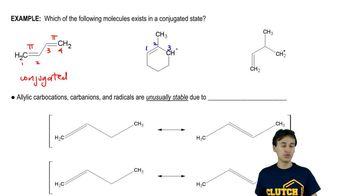
Conjugated states

Hydrogenation and Enthalpy Change (∆H°)

Hydrogenation is the process of adding hydrogen to a compound, typically resulting in the saturation of double bonds. The enthalpy change (∆H°) during hydrogenation indicates the stability of the original compound; a lower ∆H° value suggests greater stability of the starting diene, as less energy is released when converting it to a saturated alkane.
Video consigliato:
04:38
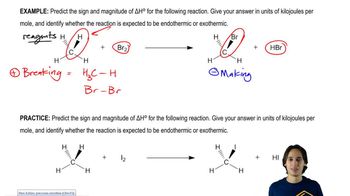
Calculating Enthalpies

Stability and Energy Considerations

In organic chemistry, the stability of a molecule is often inversely related to its energy content. More stable molecules have lower energy due to factors like resonance, sterics, and electronic effects. When comparing hexa-1,3-diene and hexa-1,4-diene, the one with the lower enthalpy of hydrogenation is considered more stable, as it indicates a more favorable energy state.
Video consigliato:
03:43
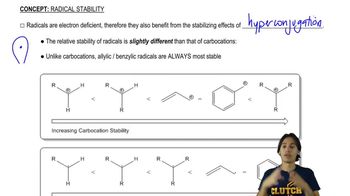
The radical stability trend.
Pratica correlata
Domanda del libro di testo

A misguided chemist attempted to synthesize trans-1,2-dimethylcyclohexane via the hydrogenation of 1,2-dimethylcyclohexene. Explain why this is not possible.

1631
views

Domanda del libro di testo

Conjugated dienes, molecules containing two alkenes separated by one single bond, are discussed in detail in Chapter 21.

(b) How might you account for this difference in stability?

1101
views
Domanda del libro di testo

Without concerning yourself with the mechanism of the reaction, calculate the equilibrium constant for the following equilibrium processes. (Assume T = 298 K.)

(a)

1033
views
Domanda del libro di testo

Identify the alkene that would react with Ti(OiPr)₄, (+) -diethyltartrate, and t-butylhydroperoxide to give the following chiral, nonracemic epoxides.

(a)

861
views
Domanda del libro di testo

Questions (a)–(d) all refer to the following reaction, which has been engineered to produce one enantiomer to the exclusion of the other.

(c) Suppose the difference in activation energy is 1.6 kcal/mol. At what temperature would you produce C in 99% ee?

983
views
Domanda del libro di testo

Because deuterium behaves like hydrogen in chemical reactions yet is detected differently, chemists use the incorporation of deuterium to better understand the subtleties of reaction mechanisms. Deuterium is incorporated by replacing H₂ with D₂ in the hydrogenation reaction. Identify the product expected when the alkenes in Assessment 9.34 react with D₂ and Pd/C. [Don't worry about showing all diastereomers.]

1609
views