Ch. 9 - Alkenes 2: Oxidation and Reduction
Mullins - Organic Chemistry: A Learner Centered Approach 1st Edition
Mullins1st EditionOrganic Chemistry: A Learner Centered ApproachISBN: 9780137566471Non è quello che usi tu?Cambia libro di testo
Capitolo 8, Problema 39c

Questions (a)–(d) all refer to the following reaction, which has been engineered to produce one enantiomer to the exclusion of the other.

(c) Suppose the difference in activation energy is 1.6 kcal/mol. At what temperature would you produce C in 99% ee?

Guida verificata passo dopo passo
1
Step 1: Understand the concept of enantiomeric excess (ee). Enantiomeric excess is a measure of the purity of one enantiomer in a mixture of two enantiomers. It is calculated using the formula: ee = (|C - B| / (C + B)) × 100%, where C and B represent the concentrations of the two enantiomers.
Step 2: Relate the difference in activation energy (ΔEa) to the ratio of enantiomers. The ratio of enantiomers can be determined using the equation: ln(C/B) = -ΔEa / (RT), where R is the gas constant (1.987 cal/(mol·K)) and T is the temperature in Kelvin.
Step 3: Use the given enantiomeric excess (99% ee) to find the ratio of enantiomers. For 99% ee, the ratio of C to B can be expressed as: C/B = (1 + ee) / (1 - ee). Substituting ee = 0.99, calculate the ratio C/B.
Step 4: Rearrange the equation ln(C/B) = -ΔEa / (RT) to solve for temperature (T). Substitute the values for ΔEa (1.6 kcal/mol, converted to cal/mol), R (1.987 cal/(mol·K)), and the calculated ratio C/B into the equation.
Step 5: Perform the calculation to determine the temperature (T) in Kelvin. Once T is found, you can convert it to Celsius if needed by subtracting 273.15 from the Kelvin value.

Risposta video verificata per un problema simile:

Questa soluzione video è stata consigliata dai nostri tutor come utile per risolvere questo problema.
Durata del video:
11m

Concetti chiave

Ecco i concetti essenziali che devi comprendere per rispondere correttamente alla domanda.

Enantiomers and Enantiomeric Excess (ee)

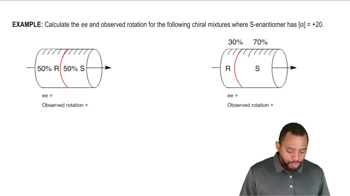
Enantiomers are pairs of molecules that are non-superimposable mirror images of each other, often differing in their spatial arrangement. Enantiomeric excess (ee) quantifies the purity of one enantiomer over the other in a mixture, expressed as a percentage. A high ee indicates a predominance of one enantiomer, which is crucial in applications like pharmaceuticals where specific enantiomers can have different biological effects.
Video consigliato:
03:59
Calculating Enantiomeric Excess and Observed Rotation

Activation Energy and Temperature

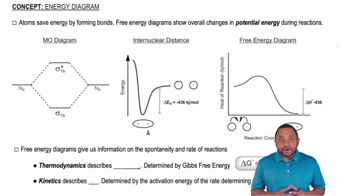
Activation energy is the minimum energy required for a chemical reaction to occur. It plays a significant role in determining the rate of a reaction; lower activation energy typically leads to a faster reaction. The relationship between activation energy and temperature can be described by the Arrhenius equation, which shows that increasing temperature can enhance the reaction rate, thereby influencing the formation of products, including enantiomers.
Video consigliato:
08:30
Introduction to free energy diagrams.

Chiral Catalysis

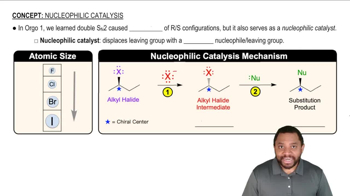
Chiral catalysis involves the use of a chiral catalyst to promote a reaction that produces one enantiomer preferentially over the other. This technique is essential in asymmetric synthesis, where the goal is to create compounds with specific stereochemistry. The presence of a chiral catalyst can lower the activation energy for the formation of one enantiomer, thus increasing the yield and ee of the desired product.
Video consigliato:
Percorso guidato
2:31
Nucleophilic Catalysis Concept 1