Ch. 9 - Alkenes 2: Oxidation and Reduction
Mullins - Organic Chemistry: A Learner Centered Approach 1st Edition
Mullins1st EditionOrganic Chemistry: A Learner Centered ApproachISBN: 9780137566471Non è quello che usi tu?Cambia libro di testo
Capitolo 8, Problema 33

Formation of the molozonide can be expected to proceed stereospecifically. Why is this the case? Show the two different molozonides you would expect to get from ozonolysis of (E)- and (Z)-3,4-dimethylhept-3-ene.
Diagram showing ozonolysis of (E)- and (Z)-3,4-dimethylhept-3-ene forming two stereospecific molozonides.

Guida verificata passo dopo passo
1
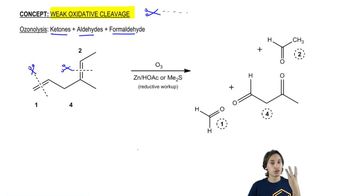
Understand the concept of ozonolysis: Ozonolysis is a reaction where ozone (O₃) cleaves alkenes to form carbonyl compounds. The initial step involves the formation of a molozonide, which is a cyclic intermediate.
Recognize stereospecificity: Stereospecific reactions lead to different stereoisomers depending on the configuration of the starting material. In this case, the stereochemistry of the alkene affects the stereochemistry of the molozonide formed.
Identify the starting materials: The problem involves (E)- and (Z)-3,4-dimethylhept-3-ene. The (E)-isomer has the two methyl groups on opposite sides of the double bond, while the (Z)-isomer has them on the same side.
Predict the molozonide formation: For the (E)-isomer, the molozonide will form with the substituents on opposite sides, maintaining the stereochemistry. For the (Z)-isomer, the molozonide will form with the substituents on the same side.
Draw the structures: Use the stereochemistry of the starting alkenes to draw the two different molozonides. Ensure that the cyclic structure reflects the stereochemistry of the original alkene, with the oxygen atoms forming a five-membered ring with the carbon atoms from the double bond.

Risposta video verificata per un problema simile:

Questa soluzione video è stata consigliata dai nostri tutor come utile per risolvere questo problema.
Durata del video:
7m

Concetti chiave

Ecco i concetti essenziali che devi comprendere per rispondere correttamente alla domanda.

Ozonolysis

Ozonolysis is a reaction where ozone (O3) cleaves alkenes to form carbonyl compounds. It involves the formation of an intermediate called molozonide, which rearranges to form ozonide before breaking down into aldehydes or ketones. Understanding the mechanism of ozonolysis is crucial for predicting the stereochemistry of the products formed from different alkenes.
Video consigliato:
06:30
General properties of ozonolysis.

Stereospecificity

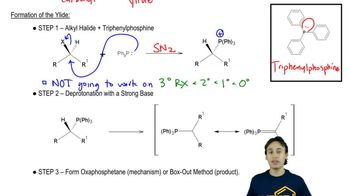
Stereospecificity refers to a reaction where the stereochemistry of the reactant determines the stereochemistry of the product. In the context of ozonolysis, the stereochemistry of the alkene (E or Z configuration) influences the formation of molozonide, leading to different stereochemical outcomes. This concept is essential for predicting the stereochemical nature of the molozonides formed from (E)- and (Z)-3,4-dimethylhept-3-ene.
Video consigliato:
15:39
Box-Out Method and Full-Mechanism

E/Z Isomerism

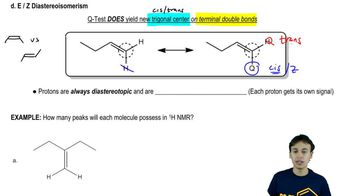
E/Z isomerism is a type of stereoisomerism found in alkenes, where the spatial arrangement of substituents around the double bond differs. E (entgegen) isomers have substituents on opposite sides, while Z (zusammen) isomers have them on the same side. This isomerism affects the stereospecific formation of molozonides during ozonolysis, as the initial geometry of the alkene dictates the stereochemistry of the resulting products.
Video consigliato:
03:48
E/Z Diastereoisomerism
Pratica correlata
Domanda del libro di testo

A misguided chemist attempted to synthesize trans-1,2-dimethylcyclohexane via the hydrogenation of 1,2-dimethylcyclohexene. Explain why this is not possible.

1631
views

Domanda del libro di testo

Suggest a synthesis of the following aldehydes or ketones using the ozonolysis reaction of an alkene.

(b)

644
views
Domanda del libro di testo

Suggest a synthesis of the following aldehydes or ketones using the ozonolysis reaction of an alkene.

(a)

1149
views
Domanda del libro di testo

Because deuterium behaves like hydrogen in chemical reactions yet is detected differently, chemists use the incorporation of deuterium to better understand the subtleties of reaction mechanisms. Deuterium is incorporated by replacing H₂ with D₂ in the hydrogenation reaction. Identify the product expected when the alkenes in Assessment 9.34 react with D₂ and Pd/C. [Don't worry about showing all diastereomers.]

1609
views
Domanda del libro di testo

What product results when the following molecules are treated with H₂ Pd/C? Be sure to indicate the relative stereochemical outcome. Draw both enantiomers of any racemic mixtures. [It is difficult to control the stoichiometry of gases so there is enough H₂ to reduce all alkenes.]

(b)

1302
views
Domanda del libro di testo

In Solved Assessment 9.30(b), we came up with an alkene that under the conditions of ozonolysis would produce acetophenone and acetaldehyde. There is one other alkene that should produce the same compounds under these conditions. Which is it?

1331
views