Ch. 9 - Alkenes 2: Oxidation and Reduction
Mullins - Organic Chemistry: A Learner Centered Approach 1st Edition
Mullins1st EditionOrganic Chemistry: A Learner Centered ApproachISBN: 9780137566471Non è quello che usi tu?Cambia libro di testo
Capitolo 8, Problema 30a

Suggest a synthesis of the following aldehydes or ketones using the ozonolysis reaction of an alkene.
(a) Ozonolysis reaction of an alkene with O3 and CH3SCH3 yielding a cyclopentanone.

Guida verificata passo dopo passo
1
Identify the target aldehyde or ketone structure that you need to synthesize. This will help you determine the alkene structure required for ozonolysis.
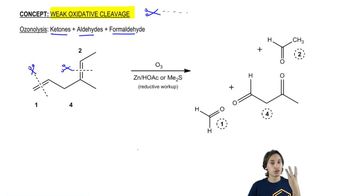
Understand the ozonolysis reaction: Ozonolysis involves the cleavage of alkenes using ozone (O₃) to form carbonyl compounds, such as aldehydes and ketones. The reaction typically proceeds through the formation of an ozonide intermediate, which is then reduced to yield the desired carbonyl products.
Determine the alkene structure: To synthesize a specific aldehyde or ketone, you need to identify the alkene that, upon ozonolysis, will yield the desired carbonyl compound. Consider the carbon chain length and the position of the double bond in the alkene that will lead to the formation of the target aldehyde or ketone.
Write the balanced chemical equation for the ozonolysis reaction: Represent the alkene and the ozone molecule in the equation, and show the formation of the ozonide intermediate. Then, indicate the reduction step that leads to the formation of the aldehyde or ketone.
Consider the reaction conditions: Ozonolysis typically requires a solvent like dichloromethane and a reducing agent such as zinc or dimethyl sulfide to convert the ozonide intermediate into the final carbonyl products. Ensure that these conditions are suitable for your synthesis.

Risposta video verificata per un problema simile:

Questa soluzione video è stata consigliata dai nostri tutor come utile per risolvere questo problema.
Durata del video:
1m

Concetti chiave

Ecco i concetti essenziali che devi comprendere per rispondere correttamente alla domanda.

Ozonolysis Reaction

Ozonolysis is a reaction where ozone (O3) cleaves alkenes to form carbonyl compounds, such as aldehydes and ketones. The reaction involves the addition of ozone to the double bond, forming an ozonide intermediate, which is then reduced to yield the carbonyl products. This reaction is useful for breaking down complex alkenes into simpler carbonyl compounds.
Video consigliato:
06:30
General properties of ozonolysis.

Alkenes

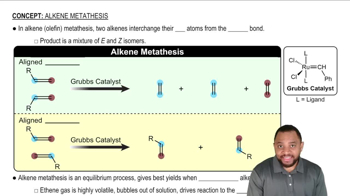
Alkenes are hydrocarbons containing at least one carbon-carbon double bond (C=C). They are unsaturated compounds, meaning they have fewer hydrogen atoms than alkanes. The double bond is a site of high reactivity, making alkenes suitable substrates for various addition reactions, including ozonolysis, which targets the double bond to form carbonyl compounds.
Video consigliato:
Percorso guidato
2:09
Alkene Metathesis Concept 1

Carbonyl Compounds

Carbonyl compounds are organic molecules containing a carbon-oxygen double bond (C=O), such as aldehydes and ketones. Aldehydes have at least one hydrogen atom attached to the carbonyl carbon, while ketones have two carbon groups. These compounds are key products in ozonolysis and are characterized by their distinct reactivity and chemical properties, which are crucial in organic synthesis.
Video consigliato:
01:40
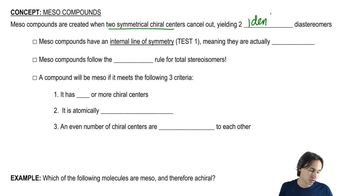
Defining meso compounds.