Ch. 9 - Alkenes 2: Oxidation and Reduction
Mullins - Organic Chemistry: A Learner Centered Approach 1st Edition
Mullins1st EditionOrganic Chemistry: A Learner Centered ApproachISBN: 9780137566471Non è quello che usi tu?Cambia libro di testo
Capitolo 8, Problema 27

In Assessment 9.26, what is the relationship between the enantiomers of compound A and the enantiomers of compound B?

Guida verificata passo dopo passo
1
Understand the concept of enantiomers: Enantiomers are pairs of molecules that are mirror images of each other but are not superimposable, much like left and right hands. They have identical physical properties except for their interaction with plane-polarized light and reactions in chiral environments.
Identify the stereocenters: Examine compound A and compound B to identify any chiral centers. A chiral center is typically a carbon atom bonded to four different groups.
Determine the configuration of each enantiomer: Assign R/S configuration to the chiral centers using the Cahn-Ingold-Prelog priority rules. This involves ranking the substituents attached to the chiral center based on atomic number and arranging them in a specific spatial orientation.
Compare the configurations: Once the configurations are assigned, compare the R/S configurations of the enantiomers of compound A with those of compound B. Enantiomers will have opposite configurations at all chiral centers.
Analyze the relationship: If the enantiomers of compound A have the same configuration as the enantiomers of compound B, they are identical. If they have opposite configurations, they are enantiomers. If they differ at some but not all chiral centers, they are diastereomers.

Risposta video verificata per un problema simile:

Questa soluzione video è stata consigliata dai nostri tutor come utile per risolvere questo problema.
Durata del video:
4m

Concetti chiave

Ecco i concetti essenziali che devi comprendere per rispondere correttamente alla domanda.

Enantiomers

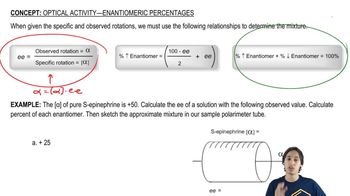
Enantiomers are a type of stereoisomer where two molecules are non-superimposable mirror images of each other. They have identical physical properties except for the direction in which they rotate plane-polarized light and their reactions in chiral environments. Understanding enantiomers is crucial for analyzing the stereochemistry of compounds A and B.
Video consigliato:
03:23
How to solve for the percentage of each enantiomer.

Chirality

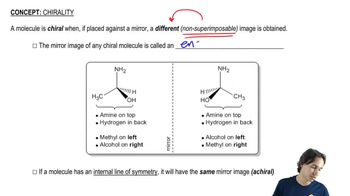
Chirality refers to the geometric property of a molecule having a non-superimposable mirror image, much like left and right hands. A chiral molecule typically has at least one carbon atom bonded to four different groups, known as a chiral center. Recognizing chiral centers in compounds A and B is essential for determining their enantiomeric relationships.
Video consigliato:
05:10
What is chirality?

Stereochemistry

Stereochemistry involves the study of the spatial arrangement of atoms in molecules and how this affects their chemical behavior. It is crucial for understanding the three-dimensional orientation of enantiomers in compounds A and B, which influences their interactions and properties. Analyzing stereochemistry helps in identifying the relationship between the enantiomers of the two compounds.
Video consigliato:
Percorso guidato
1:38
Polymer Stereochemistry Concept 1