
Despite it being equally favorable, opening of the epoxide does not happen in the absence of an acid catalyst. How does acid make the reaction faster? Demonstrate this concept by directly comparing the reaction coordinate diagram for both situations A and B.
Ch. 9 - Alkenes 2: Oxidation and Reduction

Mullins1st EditionOrganic Chemistry: A Learner Centered ApproachISBN: 9780137566471Non è quello che usi tu?Cambia libro di testo
Capitolo 8, Problema 29b
Draw the product(s) you'd expect when each of these alkenes is treated first with O3, then with CH3SCH3
(b) 
Guida verificata passo dopo passo1
Identify the alkene in the given structure. The double bond is located between the two carbon atoms connecting the isopropyl group and the cyclohexane ring.
Understand that ozonolysis involves the cleavage of the carbon-carbon double bond. Ozone (O₃) will react with the alkene to form an ozonide intermediate.
Recognize that the ozonide intermediate will be reduced by dimethyl sulfide (CH₃SCH₃) to form carbonyl compounds. Each carbon of the former double bond will become a carbonyl group.
Draw the products by replacing the double-bonded carbons with carbonyl groups. The isopropyl group will be attached to an aldehyde, and the cyclohexane ring will be attached to a ketone.
Ensure that the final structures are correctly drawn, showing an aldehyde and a ketone as the products of the ozonolysis reaction followed by reduction with dimethyl sulfide.

Risposta video verificata per un problema simile:
Questa soluzione video è stata consigliata dai nostri tutor come utile per risolvere questo problema.
Concetti chiave
Ecco i concetti essenziali che devi comprendere per rispondere correttamente alla domanda.
Ozonolysis
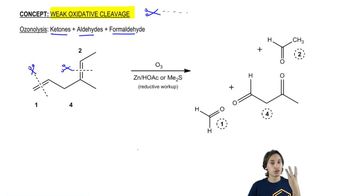
Ozonolysis is a reaction where ozone (O₃) cleaves alkenes to form carbonyl compounds. The process involves the formation of an ozonide intermediate, which is then reduced to yield aldehydes or ketones. This reaction is useful for breaking down complex alkenes into simpler, identifiable fragments.
Video consigliato:
General properties of ozonolysis.
Reductive Workup
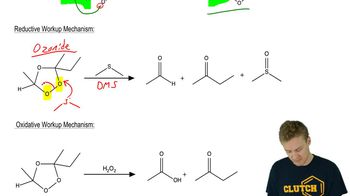
Reductive workup in ozonolysis involves using a reducing agent, such as dimethyl sulfide (CH₃SCH₃), to convert the ozonide intermediate into stable carbonyl compounds. This step prevents the formation of carboxylic acids, ensuring that aldehydes are produced instead, which is crucial for maintaining the integrity of the original carbon skeleton.
Video consigliato:
Reductive Workup Mechanism:
Alkene Structure
Understanding the structure of the alkene is essential for predicting the products of ozonolysis. The alkene in the image is a cyclohexene with an isopropyl group attached, indicating that ozonolysis will cleave the double bond, resulting in two carbonyl compounds: an aldehyde from the isopropyl group and a ketone from the cyclohexene ring.
Video consigliato:
Percorso guidato
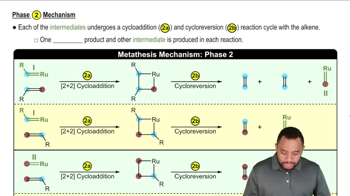
Alkene Metathesis Concept 5
Pratica correlata
Domanda del libro di testo
807
views
Domanda del libro di testo
Draw the product(s) you'd expect when each of these alkenes is treated first with O3, then with CH3SCH3
(c)
709
views
Domanda del libro di testo
Draw the product(s) you'd expect when each of these alkenes is treated first with O3, then with CH3SCH3
(a)
1357
views
Domanda del libro di testo
Draw the product(s) you'd expect when each of these alkenes is treated first with O3, then with CH3SCH3
(d)
1179
views
Domanda del libro di testo
Suggest a synthesis of the following aldehydes or ketones using the ozonolysis reaction of an alkene.
(a)
1149
views
Domanda del libro di testo
In Assessment 9.26, what is the relationship between the enantiomers of compound A and the enantiomers of compound B?
1150
views
