Ch. 9 - Alkenes 2: Oxidation and Reduction
Mullins - Organic Chemistry: A Learner Centered Approach 1st Edition
Mullins1st EditionOrganic Chemistry: A Learner Centered ApproachISBN: 9780137566471Non è quello che usi tu?Cambia libro di testo
Capitolo 8, Problema 54

In Chapter 19, we discuss the reaction of enols with bromine. This reaction produces α -bromoketones in good yields. Suggest a mechanism for this reaction and justify its deviation from the dibromide product you might have expected.

Guida verificata passo dopo passo
1
Step 1: Recognize that the reaction involves enols reacting with bromine (Br₂) to form α-bromoketones. The enol tautomer is the reactive intermediate in this process, and the reaction proceeds via electrophilic halogenation.
Step 2: Understand the mechanism begins with the enol donating electrons from its double bond to bromine (Br₂), forming a bromonium ion intermediate. This step is driven by the nucleophilicity of the enol's double bond.
Step 3: The bromonium ion is then attacked by water or another nucleophile, leading to the formation of a hydroxyl group and a bromine atom on the α-carbon. This intermediate is unstable and undergoes further transformation.
Step 4: The hydroxyl group on the α-carbon is eliminated as water, resulting in the formation of a carbonyl group (ketone). This step explains why the final product is an α-bromoketone rather than a dibromide.
Step 5: The deviation from the dibromide product occurs because the reaction mechanism favors the formation of a stable carbonyl group over the addition of a second bromine atom. The reaction stops at the α-bromoketone stage due to the stability of the ketone product.

Risposta video verificata per un problema simile:

Questa soluzione video è stata consigliata dai nostri tutor come utile per risolvere questo problema.

Concetti chiave

Ecco i concetti essenziali che devi comprendere per rispondere correttamente alla domanda.

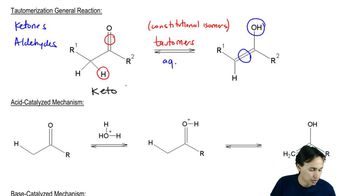
Enol Tautomerization

Enols are the keto-enol tautomer of carbonyl compounds, where the enol form contains a hydroxyl group bonded to a carbon-carbon double bond. Understanding enol tautomerization is crucial because the reaction with bromine involves the enol form, which is more reactive than the keto form. This process highlights the dynamic equilibrium between the two forms and the conditions that favor one over the other.
Video consigliato:
05:11
Tautomerization Mechanisms

Electrophilic Addition

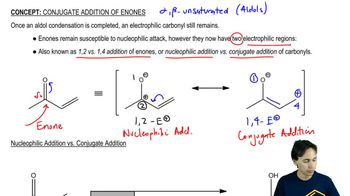
Electrophilic addition is a fundamental reaction mechanism in organic chemistry where an electrophile reacts with a nucleophile, resulting in the formation of a new bond. In the case of enols reacting with bromine, the double bond of the enol acts as a nucleophile, attacking the electrophilic bromine molecule. This step is essential for understanding how α-bromoketones are formed instead of the expected dibromide product.
Video consigliato:
09:23
1,2 vs 1,4 Addition

Regioselectivity

Regioselectivity refers to the preference of a chemical reaction to yield one structural isomer over others when multiple possibilities exist. In the reaction of enols with bromine, the regioselectivity is influenced by the stability of the resulting intermediates and products. This concept helps explain why the reaction favors the formation of α-bromoketones rather than a dibrominated product, as the more stable product is formed preferentially.
Video consigliato:
05:09
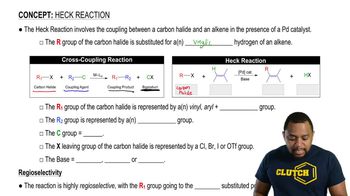
Heck Reaction
Pratica correlata
Domanda del libro di testo

Ozonolysis of an unknown alkene A gives the products shown. Predict the product that results from hydrogenation of alkene A. [There are multiple answers, but only show the one with the 6-membered ring.]

1016
views

Domanda del libro di testo

Consider the Cope rearrangement, a reaction we describe in Chapter 20.

(a) Using the knowledge we have gained here in Chapter 9, suggest a one-step, concerted mechanism that explains the formation of B from A.

(b) Which side of the reaction would you expect to be favored? Justify your answer.

(c) Which product, A or B, would you expect to be hydrogenated with the more exothermic heat of hydrogenation?

743
views
Domanda del libro di testo

Bromination of a highly electron-rich alkene such as 2-methoxybut-2-ene has been shown to produce approximately equal mixtures of the trans- and cis-dibromide. Suggest an explanation for this observation.

1635
views
Domanda del libro di testo

In spite of being mechanistically similar to some of the reactions we saw in Chapter 8, rearrangement never occurred here in Chapter 9. Why doesn't rearrangement occur in the following bromination reaction despite the proximity of a more substituted carbon?

947
views
Domanda del libro di testo

Predict the product of ozonolysis of the triglyceride shown.

1243
views
Domanda del libro di testo

Bromination of buta-1,3-diene with a single equivalent of Br2 can give either of two products. (a) Which of these products (A or B) would you predict to be more stable? Justify your answer.

1195
views