Ch. 9 - Alkenes 2: Oxidation and Reduction
Mullins - Organic Chemistry: A Learner Centered Approach 1st Edition
Mullins1st EditionOrganic Chemistry: A Learner Centered ApproachISBN: 9780137566471Non è quello che usi tu?Cambia libro di testo
Capitolo 8, Problema 45h(i)

Predict the product(s) that would result when the alkenes are allowed to react under the following conditions: (i) Br2
(h) Chemical structure of an alkene with a double bond, illustrating a reaction setup for halogenation with Br2.

Guida verificata passo dopo passo
1
Step 1: Recognize the type of reaction. The reaction involves an alkene and bromine (Br₂), which is a halogenation reaction. This reaction typically proceeds via an electrophilic addition mechanism.
Step 2: Understand the mechanism. When Br₂ reacts with an alkene, the π-electrons of the double bond attack one of the bromine atoms, forming a cyclic bromonium ion intermediate. This intermediate is positively charged and highly reactive.
Step 3: Determine the nucleophilic attack. The bromide ion (Br⁻), which is generated when Br₂ splits, attacks the more substituted carbon of the bromonium ion (if applicable, based on Markovnikov's rule). This results in the anti-addition of bromine atoms across the double bond.
Step 4: Predict the stereochemistry. Since the bromonium ion intermediate is cyclic, the attack by the bromide ion occurs from the opposite side of the ring, leading to anti-addition. This means the two bromine atoms will be added to opposite faces of the former double bond.
Step 5: Draw the product(s). The final product will be a vicinal dibromide (two bromine atoms attached to adjacent carbons). If the starting alkene is symmetrical, a single product will form. If the alkene is asymmetrical, consider the possibility of stereoisomers (e.g., enantiomers or diastereomers).

Risposta video verificata per un problema simile:

Questa soluzione video è stata consigliata dai nostri tutor come utile per risolvere questo problema.
Durata del video:
4m

Concetti chiave

Ecco i concetti essenziali che devi comprendere per rispondere correttamente alla domanda.

Electrophilic Addition

Electrophilic addition is a fundamental reaction mechanism in organic chemistry where an electrophile reacts with a nucleophile, typically involving alkenes. In the case of alkenes reacting with Br₂, the double bond acts as a nucleophile, attacking the electrophilic bromine molecule, leading to the formation of a cyclic bromonium ion intermediate.
Video consigliato:
09:23
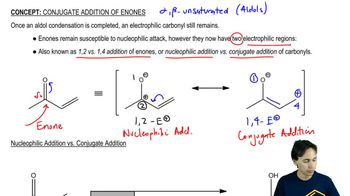
1,2 vs 1,4 Addition

Bromination of Alkenes

Bromination is a specific type of electrophilic addition where bromine (Br₂) adds across the double bond of an alkene. This reaction typically results in the formation of vicinal dibromides, where bromine atoms are added to adjacent carbon atoms. The stereochemistry of the product can vary, leading to both anti and syn addition products.
Video consigliato:
00:54
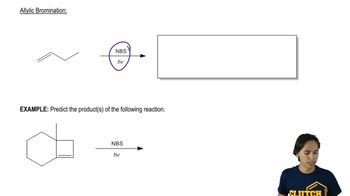
Mechanism of Allylic Bromination.

Stereochemistry of Addition Reactions

Stereochemistry refers to the spatial arrangement of atoms in molecules and how this affects their chemical behavior. In the bromination of alkenes, the addition of bromine can lead to different stereoisomers, such as enantiomers or diastereomers, depending on whether the addition occurs from the same or opposite sides of the double bond, influencing the final product's configuration.
Video consigliato:
Percorso guidato
1:38
Polymer Stereochemistry Concept 1