Ch. 9 - Alkenes 2: Oxidation and Reduction
Mullins - Organic Chemistry: A Learner Centered Approach 1st Edition
Mullins1st EditionOrganic Chemistry: A Learner Centered ApproachISBN: 9780137566471Non è quello che usi tu?Cambia libro di testo
Capitolo 8, Problema 45h(vii)

Predict the product(s) that would result when the alkenes are allowed to react under the following conditions: (vii) 1. mCPBA 2. H2SO4, H2O
(h) Chemical structure of an alkene with a double bond, illustrating a reaction mechanism for epoxidation.

Guida verificata passo dopo passo
1
Step 1: Recognize the reaction type. The problem involves a two-step reaction sequence. The first step uses mCPBA (meta-chloroperoxybenzoic acid), which is a reagent commonly used for epoxidation of alkenes. This means the double bond in the alkene will be converted into an epoxide (a three-membered cyclic ether).
Step 2: Draw the structure of the starting alkene and identify the position of the double bond. This is important because the epoxidation will occur specifically at the double bond, forming a three-membered ring with an oxygen atom.
Step 3: Apply the stereochemistry of the reaction. mCPBA reacts with alkenes in a syn addition manner, meaning the oxygen atom is added to the same face of the double bond. If the alkene is cis, the epoxide will also be cis. If the alkene is trans, the epoxide will be trans.
Step 4: Consider the second step of the reaction. Since the second step is not fully specified in the problem (indicated by '2. (h)'), you would need to clarify what reagent or condition 'h' refers to. Commonly, epoxides can undergo ring-opening reactions under acidic or basic conditions, leading to different products depending on the nucleophile and the reaction environment.
Step 5: Predict the final product(s) based on the second step. If 'h' refers to a specific reagent or condition, determine how it interacts with the epoxide. For example, under acidic conditions, the epoxide ring opens at the more substituted carbon, while under basic conditions, it opens at the less substituted carbon. Draw the possible product(s) accordingly.

Risposta video verificata per un problema simile:

Questa soluzione video è stata consigliata dai nostri tutor come utile per risolvere questo problema.

Concetti chiave

Ecco i concetti essenziali che devi comprendere per rispondere correttamente alla domanda.

Alkenes

Alkenes are hydrocarbons that contain at least one carbon-carbon double bond (C=C). They are unsaturated compounds, meaning they have fewer hydrogen atoms than alkanes. The presence of the double bond makes alkenes reactive, allowing them to undergo various addition reactions, including those with oxidizing agents like mCPBA.
Video consigliato:
Percorso guidato
2:09
Alkene Metathesis Concept 1

mCPBA (meta-Chloroperbenzoic Acid)

mCPBA is a peracid commonly used in organic chemistry for the epoxidation of alkenes. It introduces an oxygen atom across the double bond, forming an epoxide, which is a three-membered cyclic ether. This reaction is stereospecific and can lead to different products depending on the configuration of the starting alkene.
Video consigliato:
02:48
O,P-positions vs. Meta-Positions

Epoxidation

Epoxidation is a chemical reaction that converts alkenes into epoxides through the addition of an oxygen atom. This reaction is significant because epoxides are highly reactive intermediates that can undergo further transformations, such as ring-opening reactions, leading to various functional groups. Understanding the mechanism of epoxidation is crucial for predicting the products of reactions involving alkenes and oxidizing agents.
Video consigliato:
02:19
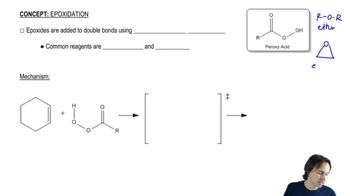
General properties of epoxidation.