Ch. 9 - Alkenes 2: Oxidation and Reduction
Mullins - Organic Chemistry: A Learner Centered Approach 1st Edition
Mullins1st EditionOrganic Chemistry: A Learner Centered ApproachISBN: 9780137566471Non è quello che usi tu?Cambia libro di testo
Capitolo 8, Problema 9

(••) Predict the product(s) that would result when the alkenes are allowed to react under the following conditions: (iii) Br₂, H₂O (h)

Guida verificata passo dopo passo
1
Identify the type of reaction: The reaction of an alkene with Br₂ in the presence of H₂O is a halohydrin formation reaction.
Understand the mechanism: The reaction proceeds via the formation of a bromonium ion intermediate, which is then attacked by water.
Determine regioselectivity: The water molecule will attack the more substituted carbon of the bromonium ion, leading to Markovnikov addition.
Consider stereochemistry: The addition of Br and OH will be anti, meaning they will add to opposite sides of the double bond.
Predict the product: The final product will be a halohydrin, with a bromine atom and a hydroxyl group added across the double bond.

Risposta video verificata per un problema simile:

Questa soluzione video è stata consigliata dai nostri tutor come utile per risolvere questo problema.

Concetti chiave

Ecco i concetti essenziali che devi comprendere per rispondere correttamente alla domanda.

Electrophilic Addition

Electrophilic addition is a fundamental reaction mechanism in organic chemistry where an electrophile reacts with a nucleophile, typically involving alkenes. In the case of alkenes reacting with Br₂, the double bond acts as a nucleophile, attacking the electrophilic bromine molecule, leading to the formation of a cyclic bromonium ion intermediate.
Video consigliato:
09:23
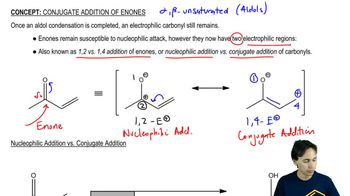
1,2 vs 1,4 Addition

Bromohydrin Formation

Bromohydrin formation occurs when an alkene reacts with bromine in the presence of water. The bromonium ion intermediate is attacked by water, leading to the formation of a bromohydrin, which is a compound containing both a bromine atom and a hydroxyl group (-OH) on adjacent carbon atoms, resulting in a vicinal dibromide.
Video consigliato:
02:26
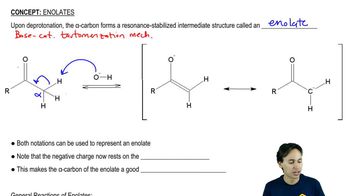
Formation of Enolates

Regioselectivity

Regioselectivity refers to the preference of a chemical reaction to yield one structural isomer over others when multiple products are possible. In the reaction of alkenes with Br₂ and H₂O, the regioselectivity is influenced by the stability of the carbocation intermediates formed during the reaction, often leading to the more substituted alcohol being produced as the major product.
Video consigliato:
05:09
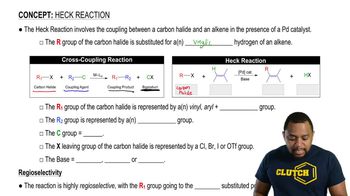
Heck Reaction