Ch. 9 - Alkenes 2: Oxidation and Reduction
Mullins - Organic Chemistry: A Learner Centered Approach 1st Edition
Mullins1st EditionOrganic Chemistry: A Learner Centered ApproachISBN: 9780137566471Non è quello che usi tu?Cambia libro di testo
Capitolo 8, Problema 45d(iv)

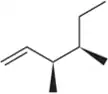
Predict the product(s) that would result when the alkenes are allowed to react under the following conditions: (iv) Cl2, CH3OH
(d) Chemical structure of an alkene with two double bonds, indicating potential sites for halogenation reactions.

Guida verificata passo dopo passo
1
Identify the type of reaction: The reaction involves an alkene reacting with Cl₂ in the presence of CH₃OH. This is an example of a halohydrin formation reaction, where the alkene undergoes an electrophilic addition reaction.
Understand the mechanism: The reaction begins with the alkene attacking a chlorine molecule (Cl₂), forming a cyclic chloronium ion intermediate. This intermediate is highly reactive and will be attacked by a nucleophile.
Determine the nucleophile: In this reaction, CH₃OH (methanol) acts as the nucleophile. Methanol will attack the more substituted carbon of the cyclic chloronium ion due to the stability of the resulting carbocation-like transition state.
Predict the product: The nucleophilic attack by CH₃OH will open the cyclic chloronium ion, resulting in the formation of a halohydrin. The product will have a chlorine atom on one carbon and a methoxy group (-OCH₃) on the adjacent carbon, with anti stereochemistry (opposite sides of the double bond plane).
Consider regioselectivity and stereochemistry: The addition of Cl and -OCH₃ will follow Markovnikov's rule, where the -OCH₃ group attaches to the more substituted carbon. Additionally, the anti stereochemistry arises due to the backside attack of the nucleophile on the cyclic intermediate.

Risposta video verificata per un problema simile:

Questa soluzione video è stata consigliata dai nostri tutor come utile per risolvere questo problema.
Durata del video:
4m

Concetti chiave

Ecco i concetti essenziali che devi comprendere per rispondere correttamente alla domanda.

Electrophilic Addition

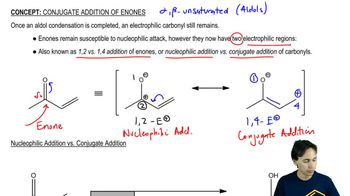
Electrophilic addition is a fundamental reaction mechanism in organic chemistry where an electrophile reacts with a nucleophile, typically involving alkenes. In this process, the double bond of the alkene acts as a nucleophile, attacking the electrophile, leading to the formation of a more stable product. Understanding this mechanism is crucial for predicting the products of reactions involving alkenes.
Video consigliato:
09:23
1,2 vs 1,4 Addition

Halogenation

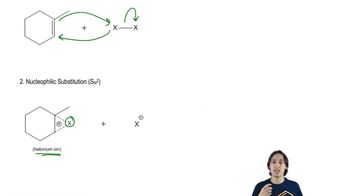
Halogenation refers to the addition of halogen atoms (like Cl₂) to an alkene, resulting in the formation of vicinal dihalides. This reaction typically proceeds through a cyclic halonium ion intermediate, which influences the stereochemistry of the product. Recognizing the nature of halogenation helps in predicting the outcome when alkenes react with halogens in various solvents.
Video consigliato:
03:45
Halogenation Mechanism

Solvent Effects

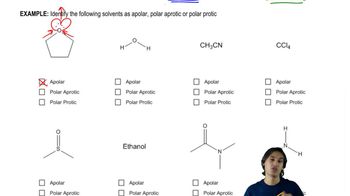
The choice of solvent can significantly influence the outcome of a chemical reaction. In the case of Cl₂ in CH₃OH (methanol), the polar protic nature of methanol can stabilize certain intermediates and facilitate the formation of products through solvation. Understanding solvent effects is essential for predicting reaction pathways and product distributions in organic reactions.
Video consigliato:
01:16
Identification of polarity in solvents