Ch. 9 - Alkenes 2: Oxidation and Reduction
Mullins - Organic Chemistry: A Learner Centered Approach 1st Edition
Mullins1st EditionOrganic Chemistry: A Learner Centered ApproachISBN: 9780137566471Non è quello che usi tu?Cambia libro di testo
Capitolo 8, Problema 22d

Which of molecules A–D would you expect to give a positive permanganate test? That is, which would result in a purple KMnO₄ solution turning brown?
(d)

Guida verificata passo dopo passo
1
Step 1: Understand the permanganate test. The permanganate test is used to identify the presence of unsaturated compounds, such as alkenes or alkynes, or functional groups that can be oxidized, such as alcohols or aldehydes. A positive test results in the purple KMnO₄ solution turning brown due to the formation of MnO₂.
Step 2: Analyze the structure of the molecule provided. The molecule contains a hydroxyl group (-OH) attached to a carbon adjacent to a ketone group (C=O). This is a beta-hydroxy ketone structure.
Step 3: Determine if the functional groups present can be oxidized by KMnO₄. The hydroxyl group (-OH) is capable of being oxidized by KMnO₄ under appropriate conditions, which could lead to a positive permanganate test.
Step 4: Consider the cyclic structure. The cyclohexane ring in the molecule is saturated and does not contain double or triple bonds, so it will not react with KMnO₄. The reactivity is focused on the hydroxyl group.
Step 5: Conclude that the molecule is likely to give a positive permanganate test due to the presence of the oxidizable hydroxyl group (-OH). The purple KMnO₄ solution would turn brown as the hydroxyl group is oxidized.

Risposta video verificata per un problema simile:

Questa soluzione video è stata consigliata dai nostri tutor come utile per risolvere questo problema.

Concetti chiave

Ecco i concetti essenziali che devi comprendere per rispondere correttamente alla domanda.

Permanganate Test

The permanganate test is a qualitative analysis used to detect the presence of alkenes and certain other functional groups in organic compounds. When an alkene is present, the purple color of potassium permanganate (KMnO₄) is reduced to brown manganese dioxide (MnO₂), indicating a reaction. This test is particularly useful for identifying unsaturation in organic molecules.
Video consigliato:
11:40
Q-Test (Proton Relationships)

Oxidation of Alcohols

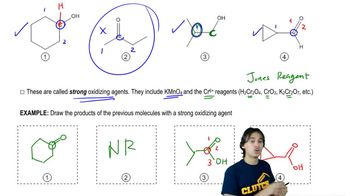
Alcohols can undergo oxidation reactions, where they are converted into carbonyl compounds such as aldehydes or ketones. The permanganate test can also indicate the presence of primary and secondary alcohols, as they can be oxidized to aldehydes and ketones, respectively. Tertiary alcohols, however, do not react in this manner, making this concept crucial for interpreting the test results.
Video consigliato:
05:53
Strong oxidizing agents

Functional Groups

Functional groups are specific groups of atoms within molecules that are responsible for the characteristic chemical reactions of those molecules. In the context of the permanganate test, the presence of double bonds (alkenes) or hydroxyl groups (alcohols) can significantly influence the outcome of the test. Understanding the functional groups present in the molecules A-D is essential for predicting their reactivity with KMnO₄.
Video consigliato:
02:36
Identifying Functional Groups