Ch.1 - Structure and Bonding
Wade - Organic Chemistry 9th Edition
Wade9th EditionOrganic ChemistryISBN: 9780135213728Non è quello che usi tu?Cambia libro di testo
Capitolo 1, Problema 56d

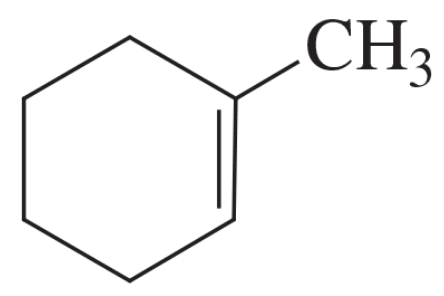
Circle the coplanar atoms in the following structure:

Guida verificata passo dopo passo
1
Identify the molecule's structure and draw it out if necessary. This will help visualize the spatial arrangement of atoms.
Understand the concept of coplanarity: Atoms are coplanar if they lie in the same geometric plane. In organic molecules, this often occurs in planar rings or conjugated systems.
Look for sp2 hybridized atoms, as these typically form planar structures due to their trigonal planar geometry. This includes atoms in double bonds or aromatic rings.
Examine any rings in the structure, such as benzene or other aromatic systems, as these are typically planar due to resonance and delocalized pi electrons.
Identify any atoms directly bonded to sp2 hybridized atoms that might also lie in the same plane due to the geometry of the molecule. Circle these atoms as they are likely to be coplanar.

Risposta video verificata per un problema simile:

Questa soluzione video è stata consigliata dai nostri tutor come utile per risolvere questo problema.
Durata del video:
4m

Concetti chiave

Ecco i concetti essenziali che devi comprendere per rispondere correttamente alla domanda.

Coplanarity in Molecules

Coplanarity refers to atoms lying in the same geometric plane. In organic molecules, coplanarity is often observed in systems with conjugated pi bonds, such as aromatic rings, where the overlapping p orbitals allow for a planar structure. Identifying coplanar atoms involves recognizing these structural features and understanding the spatial arrangement of atoms.
Video consigliato:
03:19
The Anti-Coplanar Requirement

Hybridization and Geometry

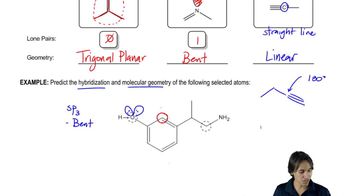
The hybridization of an atom affects its geometry and, consequently, its coplanarity. For instance, sp2 hybridized atoms typically form trigonal planar structures, which are coplanar. Recognizing the hybridization state of atoms in a molecule helps predict their spatial arrangement and identify which atoms are likely to be coplanar.
Video consigliato:
01:54
Predict the hybridization and molecular geometry

Resonance and Delocalization

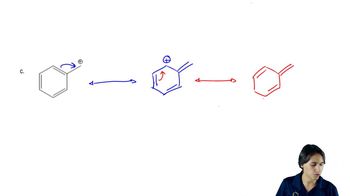
Resonance involves the delocalization of electrons across adjacent atoms, often leading to a planar structure to maximize overlap of p orbitals. In molecules with resonance, such as benzene, the delocalized electrons contribute to a stable, coplanar arrangement. Understanding resonance structures can help identify coplanar atoms by highlighting areas of electron delocalization.
Video consigliato:
03:04
Drawing Resonance Structures