Ch.1 - Structure and Bonding
Wade - Organic Chemistry 9th Edition
Wade9th EditionOrganic ChemistryISBN: 9780135213728Non è quello che usi tu?Cambia libro di testo
Capitolo 1, Problema 13e,f

Draw line-angle structures for the compounds (a) through (h).
e. (CH3)3CCOCHCH2
f. CH3COCOOH

Guida verificata passo dopo passo
1
Step 1: Understand the line-angle structure representation. In organic chemistry, line-angle structures are a simplified way to represent molecules. Each vertex or end of a line represents a carbon atom, and hydrogen atoms are usually not shown explicitly unless they are part of a functional group.
Step 2: For compound (c) CH3CH2COCN, identify the functional groups and connectivity. The compound contains an ethyl group (CH3CH2-), a carbonyl group (C=O), and a cyano group (-CN).
Step 3: Draw the line-angle structure for compound (c). Start with the ethyl group, which is represented by two connected lines. Then, connect the carbonyl group to the ethyl group, followed by the cyano group. Ensure the correct connectivity: CH3CH2-CO-CN.
Step 4: For compound (d) CH2CHCHO, identify the functional groups and connectivity. The compound contains an allyl group (CH2=CH-) and an aldehyde group (-CHO).
Step 5: Draw the line-angle structure for compound (d). Begin with the allyl group, represented by a double bond between two lines. Then, connect the aldehyde group to the allyl group. Ensure the correct connectivity: CH2=CH-CHO.

Risposta video verificata per un problema simile:

Questa soluzione video è stata consigliata dai nostri tutor come utile per risolvere questo problema.
Durata del video:
6m

Concetti chiave

Ecco i concetti essenziali che devi comprendere per rispondere correttamente alla domanda.

Line-Angle Structures

Line-angle structures, also known as skeletal formulas, are a simplified way to represent organic molecules. In these diagrams, lines represent chemical bonds, and vertices or line ends represent carbon atoms. Hydrogen atoms bonded to carbons are typically omitted for clarity, assuming each carbon forms enough bonds to satisfy its tetravalency.
Video consigliato:
02:46
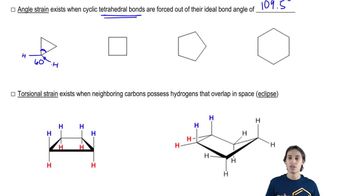
What is angle strain?

Functional Groups

Functional groups are specific groups of atoms within molecules that are responsible for the characteristic chemical reactions of those molecules. In the given compounds, recognizing functional groups like nitriles (CN) and aldehydes (CHO) is crucial for drawing accurate line-angle structures, as they dictate the connectivity and geometry of the molecule.
Video consigliato:
02:36
Identifying Functional Groups

Carbon Chain Identification

Identifying the carbon chain is essential for constructing line-angle structures. It involves recognizing the longest continuous chain of carbon atoms and any branches or substituents. For example, in CH3CH2COCN, the main chain is a three-carbon chain with a nitrile group, while CH2CHCHO features a three-carbon chain with an aldehyde group at the end.
Video consigliato:
04:25
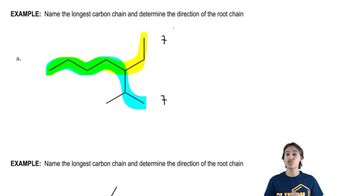
Name the longest carbon chain