Compute the empirical and molecular formulas for each of the following elemental analyses. In each case, propose at least one structure that fits the molecular formula.
Ch.1 - Structure and Bonding
Capitolo 1, Problema 13g,h
Draw line-angle structures for the compounds (a) through (h).
g. (CH3CH2)2CO
h. (CH3)3COH
Guida verificata passo dopo passo1
Identify the molecular formula for each compound. For example, (CH3CH2)2CO is diethyl ketone, and (CH3)3COH is tert-butyl alcohol.
For (CH3CH2)2CO, recognize that it is a ketone with two ethyl groups attached to the carbonyl carbon. The structure will have a central carbon double-bonded to oxygen (C=O) with two ethyl groups (CH3CH2-) attached to the central carbon.
Draw the line-angle structure for (CH3CH2)2CO: Start with the carbonyl group (C=O) and attach two lines representing the ethyl groups. Each line represents a bond, and the ends of the lines represent carbon atoms.
For (CH3)3COH, recognize that it is an alcohol with a tert-butyl group attached to the hydroxyl group. The structure will have a central carbon bonded to three methyl groups (CH3-) and one hydroxyl group (OH).
Draw the line-angle structure for (CH3)3COH: Start with a central carbon atom, attach three lines for the methyl groups, and one line for the hydroxyl group. The lines for the methyl groups should branch out from the central carbon, and the hydroxyl group should be represented by a line ending with an OH group.

Risposta video verificata per un problema simile:
Questa soluzione video è stata consigliata dai nostri tutor come utile per risolvere questo problema.
Durata del video:
3mConcetti chiave
Ecco i concetti essenziali che devi comprendere per rispondere correttamente alla domanda.
Line-Angle Structures
Line-angle structures, also known as skeletal formulas, are a simplified representation of organic molecules where lines represent chemical bonds and vertices represent carbon atoms. Hydrogen atoms attached to carbons are typically omitted for clarity, while other atoms are explicitly shown. This method is efficient for visualizing complex organic compounds.
Video consigliato:
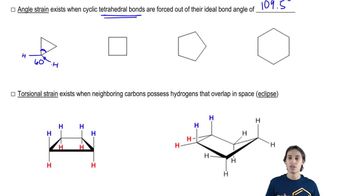
What is angle strain?
Functional Groups
Functional groups are specific groups of atoms within molecules that are responsible for the characteristic chemical reactions of those molecules. In the given compounds, the carbonyl group (C=O) in (CH3CH2)2CO and the hydroxyl group (OH) in (CH3)3COH are key functional groups that define the chemical behavior and properties of these compounds.
Video consigliato:
Identifying Functional Groups
Isomerism
Isomerism refers to the phenomenon where compounds have the same molecular formula but different structural arrangements. Understanding isomerism is crucial for drawing line-angle structures, as it helps in identifying the correct spatial arrangement of atoms. In the given compounds, recognizing the arrangement of alkyl groups around the functional groups is essential for accurate representation.
Video consigliato:
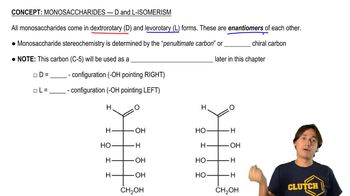
Monosaccharides - D and L Isomerism
Pratica correlata
Domanda del libro di testo
615
views
Domanda del libro di testo
Compute the empirical and molecular formulas for each of the following elemental analyses. In each case, propose at least one structure that fits the molecular formula.
795
views
Domanda del libro di testo
Draw line-angle structures for the compounds (a) through (h).
e. (CH3)3CCOCHCH2
f. CH3COCOOH
2474
views
Domanda del libro di testo
Compute the empirical and molecular formulas for each of the following elemental analyses. In each case, propose at least one structure that fits the molecular formula.
681
views
Domanda del libro di testo
Draw line-angle structures for the compounds (a) through (h).
a. CH3(CH2)3CH(CH3)2
b. (CH3)2CHCH2Cl
1656
views
Domanda del libro di testo
Draw line-angle structures for the compounds (a) through (h).
c. CH3CH2COCN
d. CH2CHCHO
2401
views