Ch.1 - Structure and Bonding
Wade - Organic Chemistry 9th Edition
Wade9th EditionOrganic ChemistryISBN: 9780135213728Non è quello che usi tu?Cambia libro di testo
Capitolo 1, Problema 44b

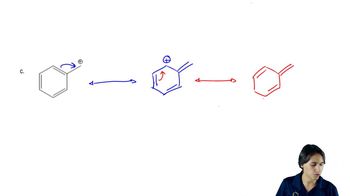
For each of these ions, draw the important resonance forms and predict which resonance form is likely to be the major contributor.
(b)

Guida verificata passo dopo passo
1
Identify the ion in the structure: The given structure is a benzyl anion, where the negative charge is located on the CH2 group attached to the benzene ring.
Draw the first resonance structure: Move the lone pair of electrons from the negatively charged carbon to form a double bond with the adjacent carbon atom in the benzene ring. This will push the electrons in the adjacent double bond towards the next carbon atom, creating a new resonance structure.
Draw the second resonance structure: Continue the electron movement by pushing the electrons from the newly formed double bond to the next carbon-carbon double bond in the benzene ring, creating another resonance structure with the negative charge now on a different carbon atom in the ring.
Draw the third resonance structure: Repeat the electron movement process to push the electrons from the current double bond to the next carbon-carbon double bond, resulting in a resonance structure with the negative charge on yet another carbon atom in the benzene ring.
Predict the major contributor: Evaluate the resonance structures based on stability. The major contributor is typically the one where the negative charge is on the most electronegative atom or the one that maintains aromaticity. In this case, the structure that maintains the aromaticity of the benzene ring and has the negative charge on the CH2 group is likely the major contributor.

Risposta video verificata per un problema simile:

Questa soluzione video è stata consigliata dai nostri tutor come utile per risolvere questo problema.
Durata del video:
6m

Concetti chiave

Ecco i concetti essenziali che devi comprendere per rispondere correttamente alla domanda.

Resonance Structures

Resonance structures are different Lewis structures for a molecule that depict the same arrangement of atoms but differ in the distribution of electrons. They are used to represent delocalized electrons within certain molecules where the bonding cannot be expressed by a single Lewis structure. The true structure is a hybrid of all possible resonance forms, contributing to the molecule's stability.
Video consigliato:
03:04
Drawing Resonance Structures

Major Resonance Contributor

The major resonance contributor is the resonance structure that most accurately represents the molecule's electron distribution. It typically has the lowest energy, which is achieved by minimizing formal charges, maximizing covalent bonds, and placing negative charges on more electronegative atoms. This structure contributes most to the resonance hybrid, influencing the molecule's properties.
Video consigliato:
03:04
Drawing Resonance Structures

Electronegativity and Charge Distribution

Electronegativity is the tendency of an atom to attract electrons towards itself. In resonance structures, the distribution of charges is influenced by electronegativity, with negative charges preferably residing on more electronegative atoms like oxygen. This affects the stability of resonance forms, as structures with charges on appropriate atoms are more stable and likely to be major contributors.
Video consigliato:
1:47
Electronegativity