Ch.1 - Structure and Bonding
Wade - Organic Chemistry 9th Edition
Wade9th EditionOrganic ChemistryISBN: 9780135213728Non è quello che usi tu?Cambia libro di testo
Capitolo 1, Problema 46a,b,c

Use resonance structures to identify the areas of high and low electron density in the following compounds:
(a)
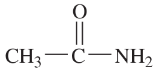
(b)
(c)

Guida verificata passo dopo passo
1
Identify the functional groups in each compound: (a) CH3C(=O)H is an aldehyde, (b) CH3C(=O)NH2 is an amide, and (c) CH3C(=NH)H is an imine.
For compound (a), draw the resonance structure by moving the lone pair of electrons from the oxygen to form a double bond with the carbon, resulting in a positive charge on the oxygen and a negative charge on the carbon.
For compound (b), draw the resonance structure by moving the lone pair of electrons from the nitrogen to form a double bond with the carbon, resulting in a positive charge on the nitrogen and a negative charge on the oxygen.
For compound (c), draw the resonance structure by moving the lone pair of electrons from the nitrogen to form a double bond with the carbon, resulting in a positive charge on the nitrogen and a negative charge on the carbon.
Analyze the resonance structures to determine areas of high and low electron density: areas with negative charges or lone pairs are high in electron density, while areas with positive charges are low in electron density.

Risposta video verificata per un problema simile:

Questa soluzione video è stata consigliata dai nostri tutor come utile per risolvere questo problema.
Durata del video:
6m

Concetti chiave

Ecco i concetti essenziali che devi comprendere per rispondere correttamente alla domanda.

Resonance Structures

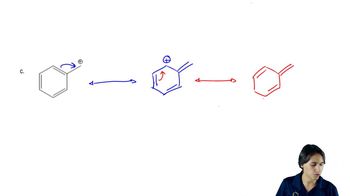
Resonance structures are different ways of drawing the same molecule that illustrate the delocalization of electrons. They help in understanding the distribution of electron density across a molecule, which can affect its reactivity and stability. Each resonance structure contributes to the overall hybrid structure, which is a more accurate representation of the molecule's electron distribution.
Video consigliato:
03:04
Drawing Resonance Structures

Electron Density

Electron density refers to the probability of finding electrons in a particular region of a molecule. Areas of high electron density are typically associated with negative charges or lone pairs, while areas of low electron density may correspond to positive charges or electron-deficient sites. Understanding electron density is crucial for predicting molecular behavior, including reactivity and interaction with other molecules.
Video consigliato:
03:54
The 18 and 16 Electron Rule

Functional Groups

Functional groups are specific groups of atoms within molecules that are responsible for the characteristic chemical reactions of those molecules. They determine the properties and reactivity of organic compounds. Recognizing functional groups in resonance structures can help identify regions of high and low electron density, as different groups can withdraw or donate electron density through resonance.
Video consigliato:
02:36
Identifying Functional Groups