Ch. 2 - Acids and Bases; Functional Groups
Wade - Organic Chemistry 9th Edition
Wade9th EditionOrganic ChemistryISBN: 9780135213728Non è quello che usi tu?Cambia libro di testo
Capitolo 2, Problema 9b

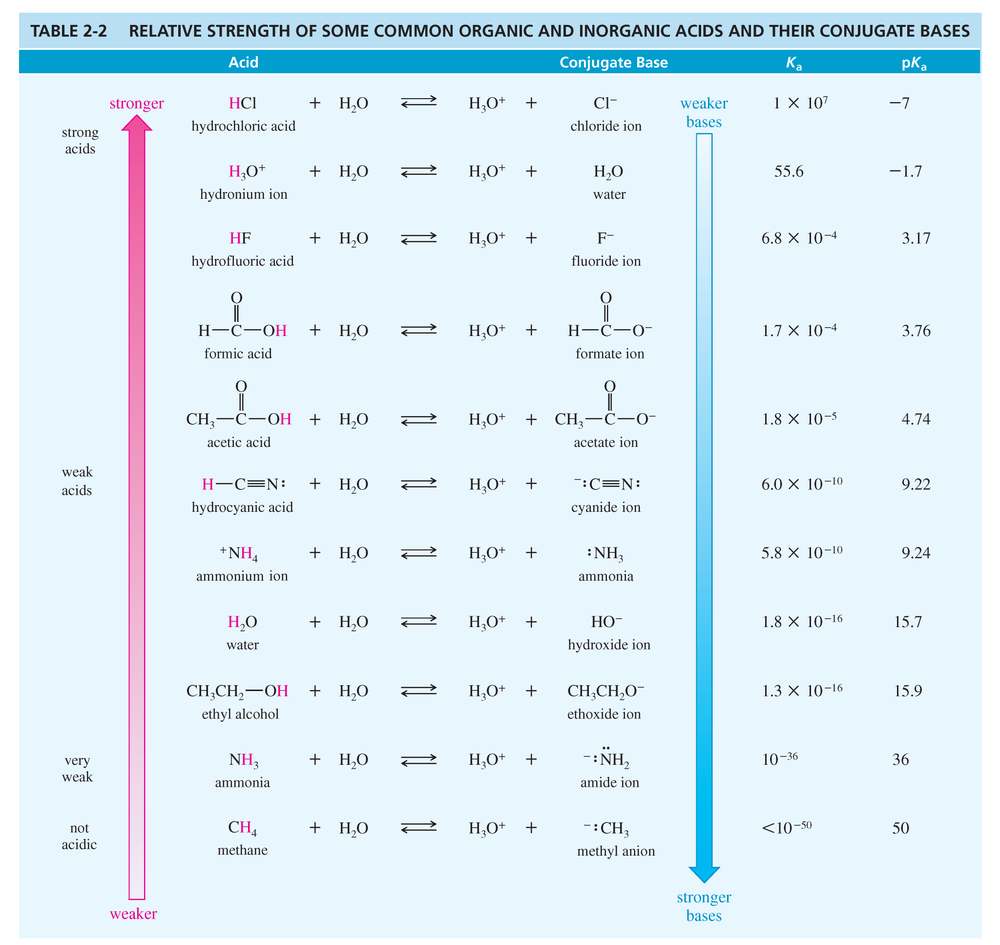
Ammonia appears in [TABLE 2-2 ] as both an acid and a conjugate base. a. Explain how ammonia can act as both an acid and a base. Which of these roles does it commonly fill in aqueous solutions?
b. Show how water can serve as both an acid and a base.

Guida verificata passo dopo passo
1
Ammonia (NH₃) can act as both an acid and a base due to its ability to donate and accept protons. As a base, ammonia accepts a proton from water, forming ammonium ion (NH₄⁺) and hydroxide ion (OH⁻). As an acid, ammonia can donate a proton to form the amide ion (NH₂⁻). In aqueous solutions, ammonia commonly acts as a base, accepting protons from water.
Water (H₂O) can serve as both an acid and a base due to its amphoteric nature. As an acid, water can donate a proton to form hydroxide ion (OH⁻). As a base, water can accept a proton to form hydronium ion (H₃O⁺). This dual ability allows water to participate in acid-base reactions in both roles.
In the table, ammonia is shown as a conjugate base of the ammonium ion (NH₄⁺), indicating its role as a base when it accepts a proton. The equilibrium reaction is: NH₄⁺ + H₂O ⇌ H₃O⁺ + NH₃.
The table also shows water as both an acid and a conjugate base. As an acid, water donates a proton to form hydroxide ion (OH⁻), and as a base, it accepts a proton to form hydronium ion (H₃O⁺). The equilibrium reactions are: H₂O + H₂O ⇌ H₃O⁺ + OH⁻.
The concept of conjugate acid-base pairs is crucial in understanding these roles. A conjugate acid is formed when a base gains a proton, and a conjugate base is formed when an acid loses a proton. This concept helps explain the dual roles of ammonia and water in acid-base chemistry.

Risposta video verificata per un problema simile:

Questa soluzione video è stata consigliata dai nostri tutor come utile per risolvere questo problema.
Durata del video:
5m

Concetti chiave

Ecco i concetti essenziali che devi comprendere per rispondere correttamente alla domanda.

Amphoteric Nature of Substances

Ammonia (NH3) is amphoteric, meaning it can act as both an acid and a base. As a base, it can accept a proton (H+) to form the ammonium ion (NH4+). Conversely, it can donate a proton in the presence of a stronger base, thus acting as an acid. This dual behavior is crucial for understanding its role in various chemical reactions, especially in aqueous solutions.
Video consigliato:
Percorso guidato
0:55
Fatty Acids Example 1

Conjugate Acid-Base Pairs

In acid-base chemistry, every acid has a conjugate base and vice versa. When ammonia acts as a base, it forms its conjugate acid, the ammonium ion (NH4+). Conversely, when it acts as an acid, it donates a proton to form its conjugate base, which is the amide ion (NH2-). Understanding these pairs helps clarify the equilibrium between acids and bases in solution.
Video consigliato:
Percorso guidato
2:56
Base Pairing Concept 1

Water as an Acid and Base

Water (H2O) is also amphoteric and can act as both an acid and a base. It can donate a proton to form the hydroxide ion (OH-) when acting as an acid, or accept a proton to form the hydronium ion (H3O+) when acting as a base. This property is fundamental in many chemical reactions, particularly in aqueous environments, where water is often the solvent.
Video consigliato:
Percorso guidato
4:47
Metal Ion Catalysis: Water Activation Concept 2
Pratica correlata