Ch. 2 - Acids and Bases; Functional Groups
Wade - Organic Chemistry 9th Edition
Wade9th EditionOrganic ChemistryISBN: 9780135213728Non è quello che usi tu?Cambia libro di testo
Capitolo 2, Problema 17a,b

Consider each pair of bases, and explain which one is more basic. Draw their conjugate acids, and show which one is a stronger acid.
(a)
(b)

Guida verificata passo dopo passo
1
Step 1: Identify the bases in each pair. In image (a), the bases are a cyclopentyl acetylide anion and a cyclopentyl vinyl anion. In image (b), the bases are cyclopentanol and cyclopentanone.
Step 2: Consider the factors that affect basicity. Basicity is influenced by the stability of the conjugate acid formed when the base accepts a proton. More stable conjugate acids correspond to weaker bases.
Step 3: Draw the conjugate acids for each base. For the cyclopentyl acetylide anion, the conjugate acid is cyclopentyl acetylene. For the cyclopentyl vinyl anion, the conjugate acid is cyclopentyl ethylene. For cyclopentanol, the conjugate acid is cyclopentan-1-olium ion, and for cyclopentanone, the conjugate acid is cyclopentanone oxonium ion.
Step 4: Analyze the stability of the conjugate acids. Cyclopentyl acetylene is less stable than cyclopentyl ethylene due to the presence of a triple bond, which is less stable than a double bond. Cyclopentan-1-olium ion is less stable than cyclopentanone oxonium ion due to the positive charge on the oxygen in the oxonium ion, which is more stable than a positive charge on carbon.
Step 5: Determine which base is more basic. The cyclopentyl acetylide anion is more basic than the cyclopentyl vinyl anion because its conjugate acid is less stable. Cyclopentanol is more basic than cyclopentanone because its conjugate acid is less stable.

Risposta video verificata per un problema simile:

Questa soluzione video è stata consigliata dai nostri tutor come utile per risolvere questo problema.
Durata del video:
8m

Concetti chiave

Ecco i concetti essenziali che devi comprendere per rispondere correttamente alla domanda.

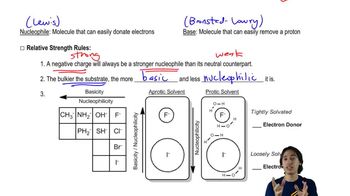
Basicity

Basicity refers to the ability of a species to accept protons (H+ ions). In organic chemistry, the strength of a base is often determined by the stability of its conjugate acid. A more basic compound will have a stronger tendency to accept protons, which is influenced by factors such as electronegativity, resonance, and steric hindrance.
Video consigliato:
06:21
Understanding the difference between basicity and nucleophilicity.

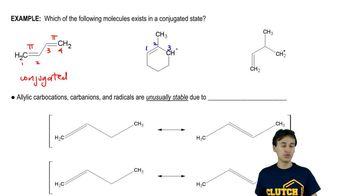
Conjugate Acids

Conjugate acids are formed when a base accepts a proton. The strength of a conjugate acid is inversely related to the strength of its corresponding base; a stronger base will have a weaker conjugate acid. Understanding the relationship between bases and their conjugate acids is crucial for predicting acid-base behavior in reactions.
Video consigliato:
03:27
Conjugated states

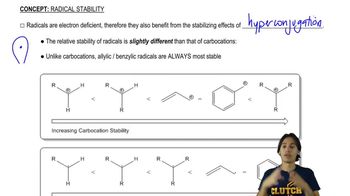
Resonance Stabilization

Resonance stabilization occurs when a molecule can be represented by multiple valid Lewis structures, allowing for the delocalization of electrons. This delocalization can enhance the stability of both bases and their conjugate acids. In the context of basicity, a base that can stabilize its negative charge through resonance will generally be more basic than one that cannot.
Video consigliato:
03:43
The radical stability trend.
Pratica correlata
Domanda del libro di testo

Which is a stronger base: ethoxide ion or acetate ion? Give pKb values (without looking them up) to support your choice.

724
views

Domanda del libro di testo

Consider the type of orbitals involved, and rank the following nitrogen compounds in order of decreasing basicity. 2. Rank the conjugate acids in order of increasing acidity. (Hint: These two orders should be the same!)

1256
views
Domanda del libro di testo

Like nitrogen and carbon, oxygen also shows this same hybridization effect on acidity. Both of the following compounds can lose a proton from a positively charged oxygen with three bonds to give a conjugate base containing a neutral oxygen with two bonds. One of these structures has pKa = −2.4, while the other has pKa = −8.0.

a. Show the reaction of each compound with water.

b. Match each structure with its pKa, and explain your choice.

953
views
Domanda del libro di testo

Acetic acid can also react as a very weak base (pKb = 20). Two different sites on acetic acid might become protonated to give the conjugate acid. Draw both of these possible conjugate acids, and explain (resonance) why the correct one is more stable. Calculate the pKa of this conjugate acid.

1027
views
Domanda del libro di testo

Give the structures of their conjugate acids, and estimate their pKas from similar compounds in Appendix 4.

1049
views
Domanda del libro di testo

Choose the more acidic member of each pair of isomers, and show why the acid you chose is more acidic.

(a)

(b)

(c)

2040
views