
Ch. 2 - Acids and Bases; Functional Groups
Wade - Organic Chemistry 9th Edition
Wade9th EditionOrganic ChemistryISBN: 9780135213728Non è quello che usi tu?Cambia libro di testo
Capitolo 2, Problema 18

Which is a stronger base: ethoxide ion or acetate ion? Give pKb values (without looking them up) to support your choice.

Guida verificata passo dopo passo
1
Identify the conjugate acids of the given bases: Ethoxide ion (C₂H₅O⁻) is the conjugate base of ethanol (C₂H₅OH), and acetate ion (CH₃COO⁻) is the conjugate base of acetic acid (CH₃COOH).
Recall that the strength of a base is inversely related to the strength of its conjugate acid. A weaker conjugate acid corresponds to a stronger base.
Consider the acidity of the conjugate acids: Ethanol is a weaker acid compared to acetic acid. This is because ethanol lacks the resonance stabilization that acetic acid has, which makes acetic acid a stronger acid.
Since ethanol is a weaker acid, its conjugate base, the ethoxide ion, is a stronger base compared to the acetate ion.
Estimate the pKb values: Since ethoxide ion is a stronger base, it will have a lower pKb value compared to the acetate ion. The exact pKb values are not needed, but this reasoning supports the conclusion that ethoxide ion is the stronger base.

Risposta video verificata per un problema simile:

Questa soluzione video è stata consigliata dai nostri tutor come utile per risolvere questo problema.
Durata del video:
4m

Concetti chiave

Ecco i concetti essenziali che devi comprendere per rispondere correttamente alla domanda.

Acid-Base Strength

The strength of a base is determined by its ability to accept protons. A stronger base has a higher tendency to accept protons, which is often reflected in its pKb value. The lower the pKb, the stronger the base. Understanding this concept helps compare the basicity of ethoxide and acetate ions.
Video consigliato:
Percorso guidato
2:50
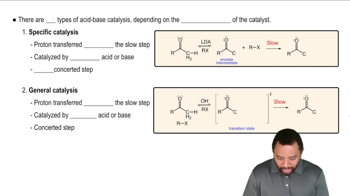
Acid-Base Catalysis Concept 3

Resonance Stabilization

Resonance stabilization occurs when a molecule can delocalize electrons across multiple atoms, reducing its reactivity. Acetate ion is resonance-stabilized, making it less reactive and a weaker base compared to ethoxide ion, which lacks such stabilization. This concept is crucial for understanding why ethoxide is a stronger base.
Video consigliato:
03:43
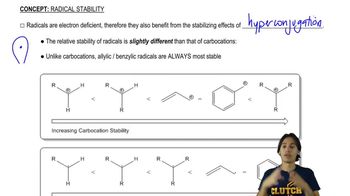
The radical stability trend.

Inductive Effect

The inductive effect involves the transmission of charge through a chain of atoms in a molecule, affecting its acidity or basicity. In ethoxide ion, the electron-donating effect of the ethyl group increases electron density on the oxygen, enhancing its basicity. This concept helps explain the relative strength of ethoxide as a base compared to acetate.
Video consigliato:
01:47
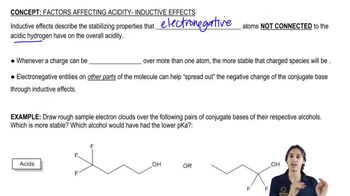
Understanding the Inductive Effect.