Ch. 2 - Acids and Bases; Functional Groups
Wade - Organic Chemistry 9th Edition
Wade9th EditionOrganic ChemistryISBN: 9780135213728Non è quello che usi tu?Cambia libro di testo
Capitolo 2, Problema 51b

In each reaction, label the reactants as Lewis acids (electrophiles) or Lewis bases (nucleophiles). Use curved arrows to show the movement of electron pairs in the reactions. Draw any nonbonding electrons to show how they participate in the reactions.
(b)

Guida verificata passo dopo passo
1
Identify the reactants: (CH3)2NH and CH3Cl. Determine which is the Lewis acid and which is the Lewis base. A Lewis acid is an electron pair acceptor, while a Lewis base is an electron pair donor.
Recognize that (CH3)2NH has a lone pair of electrons on the nitrogen atom, making it a Lewis base (nucleophile) because it can donate an electron pair.
Identify CH3Cl as the Lewis acid (electrophile) because the carbon atom is electron-deficient due to the electronegativity of the chlorine atom, making it capable of accepting an electron pair.
Use curved arrows to indicate the movement of electron pairs: Draw a curved arrow from the lone pair on the nitrogen atom of (CH3)2NH to the carbon atom of CH3Cl, showing the formation of a new bond.
Show the result of the electron movement: The nitrogen atom forms a bond with the carbon atom, resulting in (CH3)3(+NH) with a positive charge on nitrogen due to the addition of a proton, and Cl- as the leaving group with a negative charge.

Risposta video verificata per un problema simile:

Questa soluzione video è stata consigliata dai nostri tutor come utile per risolvere questo problema.
Durata del video:
3m

Concetti chiave

Ecco i concetti essenziali che devi comprendere per rispondere correttamente alla domanda.

Lewis Acids and Bases

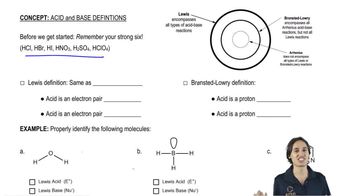
Lewis acids are species that accept electron pairs, while Lewis bases donate electron pairs. In the given reaction, (CH3)2NH acts as a Lewis base because it donates an electron pair, and CH3Cl acts as a Lewis acid by accepting the electron pair, facilitating the formation of a new bond.
Video consigliato:
02:49
The Lewis definition of acids and bases.

Curved Arrow Notation

Curved arrows are used in organic chemistry to depict the movement of electron pairs during chemical reactions. In this reaction, arrows should be drawn from the lone pair on the nitrogen atom in (CH3)2NH to the carbon atom in CH3Cl, indicating the nucleophilic attack and bond formation, and from the bond between carbon and chlorine to chlorine, showing bond cleavage.
Video consigliato:
06:20
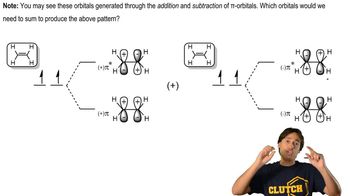
Alternative MO Notation for Dienes

Nonbonding Electrons

Nonbonding electrons, or lone pairs, are valence electrons not involved in bonding. They play a crucial role in reactions as they can be donated to form new bonds. In this reaction, the lone pair on the nitrogen atom in (CH3)2NH is essential for the nucleophilic attack on CH3Cl, leading to the formation of (CH3)3(+NH) and Cl-.
Video consigliato:
03:54
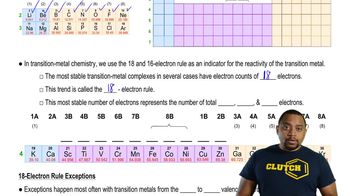
The 18 and 16 Electron Rule
Pratica correlata
Domanda del libro di testo

Label the reactants in these acid–base reactions as Lewis acids (electrophiles) or Lewis bases (nucleophiles). Use curved arrows to show the movement of electron pairs in the reactions.

(d)

1867
views

Domanda del libro di testo

Label the reactants in these acid–base reactions as Lewis acids (electrophiles) or Lewis bases (nucleophiles). Use curved arrows to show the movement of electron pairs in the reactions.

i.

942
views
Domanda del libro di testo

Each of these compounds can react as an electrophile. In each case, use curved arrows to show how the electrophile would react with the strong nucleophile sodium ethoxide, Na+ −OCH2CH3.

a.

b. NH4+

1650
views
1
rank
Domanda del libro di testo

In each reaction, label the reactants as Lewis acids (electrophiles) or Lewis bases (nucleophiles). Use curved arrows to show the movement of electron pairs in the reactions. Draw any nonbonding electrons to show how they participate in the reactions.

c.

750
views
Domanda del libro di testo

In each reaction, label the reactants as Lewis acids (electrophiles) or Lewis bases (nucleophiles). Use curved arrows to show the movement of electron pairs in the reactions. Draw any nonbonding electrons to show how they participate in the reactions.

(a)

1597
views
Domanda del libro di testo

Each of these compounds can react as an electrophile. In each case, use curved arrows to show how the electrophile would react with the strong nucleophile sodium ethoxide, Na+ −OCH2CH3.

(c) CH3CH2Br

(d) BH3

1471
views