Ch. 2 - Acids and Bases; Functional Groups
Wade - Organic Chemistry 9th Edition
Wade9th EditionOrganic ChemistryISBN: 9780135213728Non è quello che usi tu?Cambia libro di testo
Capitolo 2, Problema 52a,b

Each of these compounds can react as an electrophile. In each case, use curved arrows to show how the electrophile would react with the strong nucleophile sodium ethoxide, Na+ −OCH2CH3.
a.
b. NH4+

Guida verificata passo dopo passo
1
Identify the electrophilic center in each compound. For compound (a), the carbonyl carbon is electrophilic due to the polarization of the C=O bond. For compound (b), the nitrogen atom in NH4+ is electrophilic due to its positive charge.
Consider the nucleophile, sodium ethoxide (Na+ −OCH2CH3). The ethoxide ion (−OCH2CH3) is a strong nucleophile due to the presence of a negatively charged oxygen atom.
For compound (a), draw a curved arrow from the lone pair on the oxygen atom of the ethoxide ion to the electrophilic carbonyl carbon. This represents the nucleophilic attack on the carbonyl carbon.
For compound (b), draw a curved arrow from the lone pair on the oxygen atom of the ethoxide ion to the nitrogen atom in NH4+. This represents the nucleophilic attack on the positively charged nitrogen.
After the nucleophilic attack, consider the possible rearrangements or changes in bonding. For compound (a), the carbonyl oxygen may become negatively charged, and for compound (b), the nitrogen may lose a proton, resulting in NH3.

Risposta video verificata per un problema simile:

Questa soluzione video è stata consigliata dai nostri tutor come utile per risolvere questo problema.
Durata del video:
3m

Concetti chiave

Ecco i concetti essenziali che devi comprendere per rispondere correttamente alla domanda.

Electrophiles

Electrophiles are species that accept electron pairs from nucleophiles during chemical reactions. They are typically positively charged or have a partial positive charge, making them attractive to electron-rich species. In the context of organic reactions, understanding the nature of electrophiles is crucial for predicting reaction pathways and mechanisms.
Video consigliato:
03:
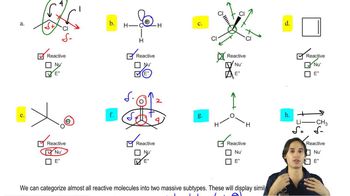
Nucleophile or Electrophile

Nucleophiles

Nucleophiles are electron-rich species that donate an electron pair to electrophiles in a chemical reaction. They can be negatively charged ions or neutral molecules with lone pairs of electrons. Recognizing the strength and reactivity of nucleophiles, such as sodium ethoxide in this case, is essential for understanding how they interact with electrophiles.
Video consigliato:
08:27
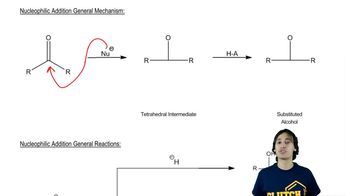
Nucleophilic Addition

Curved Arrows in Mechanisms

Curved arrows are used in organic chemistry to illustrate the movement of electron pairs during chemical reactions. The tail of the arrow indicates the source of the electrons, while the head points to the destination. Mastery of using curved arrows is vital for accurately depicting reaction mechanisms and understanding how reactants transform into products.
Video consigliato:
04:32
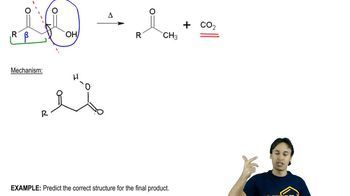
General Mechanism
Pratica correlata
Domanda del libro di testo

Each of these compounds can react as a nucleophile. In each case, use curved arrows to show how the nucleophile would react with the strong electrophile BF3.

(e) CH3CH2OH

552
views

Domanda del libro di testo

In each reaction, label the reactants as Lewis acids (electrophiles) or Lewis bases (nucleophiles). Use curved arrows to show the movement of electron pairs in the reactions. Draw any nonbonding electrons to show how they participate in the reactions.

(b)

1531
views
Domanda del libro di testo

In each reaction, label the reactants as Lewis acids (electrophiles) or Lewis bases (nucleophiles). Use curved arrows to show the movement of electron pairs in the reactions. Draw any nonbonding electrons to show how they participate in the reactions.

c.

750
views
Domanda del libro di testo

In each reaction, label the reactants as Lewis acids (electrophiles) or Lewis bases (nucleophiles). Use curved arrows to show the movement of electron pairs in the reactions. Draw any nonbonding electrons to show how they participate in the reactions.

(a)

1597
views
Domanda del libro di testo

Each of these compounds can react as an electrophile. In each case, use curved arrows to show how the electrophile would react with the strong nucleophile sodium ethoxide, Na+ −OCH2CH3.

(c) CH3CH2Br

(d) BH3

1471
views
Domanda del libro di testo

Each of these compounds can react as a nucleophile. In each case, use curved arrows to show how the nucleophile would react with the strong electrophile BF3.

(a)

(b)

1209
views