Ch. 2 - Acids and Bases; Functional Groups
Wade - Organic Chemistry 9th Edition
Wade9th EditionOrganic ChemistryISBN: 9780135213728Non è quello che usi tu?Cambia libro di testo
Capitolo 2, Problema 42h

Predict the products of the following acid–base reactions.
(h)

Guida verificata passo dopo passo
1
Identify the acid and base in the reaction. In this case, +NH3CH2COOH is the acid, and -OH is the base.
Recognize that the acid, +NH3CH2COOH, has two acidic protons: one on the ammonium group (+NH3) and one on the carboxylic acid group (COOH).
Understand that the hydroxide ion (-OH) will deprotonate the most acidic proton first. Typically, the carboxylic acid proton is more acidic than the ammonium proton.
Write the deprotonation reaction of the carboxylic acid group: +NH3CH2COOH + -OH → +NH3CH2COO- + H2O.
Consider the possibility of further deprotonation. The ammonium group can also be deprotonated by another hydroxide ion: +NH3CH2COO- + -OH → NH2CH2COO- + H2O.

Risposta video verificata per un problema simile:

Questa soluzione video è stata consigliata dai nostri tutor come utile per risolvere questo problema.
Durata del video:
2m

Concetti chiave

Ecco i concetti essenziali che devi comprendere per rispondere correttamente alla domanda.

Acid-Base Reactions

Acid-base reactions involve the transfer of protons (H+) between reactants. In this context, the amino acid +NH3CH2COOH acts as an acid, donating protons to the base, which is the hydroxide ion (OH-). Understanding the nature of acids and bases, including their ability to donate or accept protons, is crucial for predicting the products of such reactions.
Video consigliato:
02:49
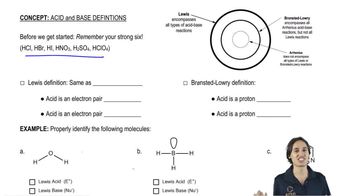
The Lewis definition of acids and bases.

Zwitterions

A zwitterion is a molecule with both positive and negative charges, but which is overall electrically neutral. Amino acids like +NH3CH2COOH can exist as zwitterions, where the amino group is protonated (+NH3) and the carboxyl group is deprotonated (COO-). Recognizing this form is essential for understanding how amino acids behave in different pH environments, especially in acid-base reactions.
Video consigliato:
04:41
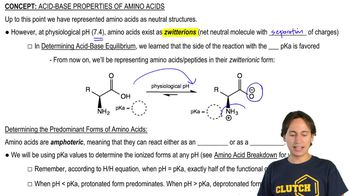
Why Amino Acids Exist as Zwitterions

Deprotonation

Deprotonation is the removal of a proton (H+) from a molecule, resulting in the formation of a conjugate base. In the given reaction, the hydroxide ions (OH-) will deprotonate the amino acid, leading to the formation of water and the conjugate base of the amino acid. This process is key to predicting the products of the reaction, as it determines the new chemical species formed.
Video consigliato:
Percorso guidato
4:30
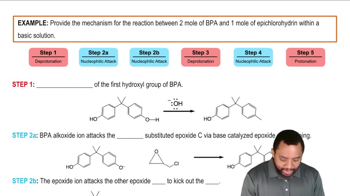
Step-Growth Polymers: Epoxy Resin Example 1