Ch. 2 - Acids and Bases; Functional Groups
Wade - Organic Chemistry 9th Edition
Wade9th EditionOrganic ChemistryISBN: 9780135213728Non è quello che usi tu?Cambia libro di testo
Capitolo 2, Problema 45a

The following compounds can all react as acids.

a. For each compound, show its conjugate base. Show any resonance forms if applicable. b. Rank the conjugate bases in the order you would predict, from most stable to least stable.

Guida verificata passo dopo passo
1
Identify the acidic hydrogen in each compound. For carboxylic acids like CH3COOH, CF3COOH, and CF3CH2COOH, the acidic hydrogen is the one attached to the oxygen in the -COOH group. For alcohols like CH3CH2OH, the acidic hydrogen is the one attached to the oxygen in the -OH group.
Remove the acidic hydrogen from each compound to form the conjugate base. For example, removing the hydrogen from CH3COOH results in CH3COO⁻.
Draw any resonance structures for the conjugate bases. For carboxylate ions like CH3COO⁻, resonance can be shown by delocalizing the negative charge between the two oxygen atoms.
Consider the stability of each conjugate base. Factors affecting stability include resonance, electronegativity, and inductive effects. For instance, the presence of electronegative atoms like fluorine in CF3COO⁻ can stabilize the conjugate base through inductive effects.
Rank the conjugate bases from most stable to least stable based on the factors discussed. Generally, more resonance and greater electronegativity lead to more stable conjugate bases.

Risposta video verificata per un problema simile:

Questa soluzione video è stata consigliata dai nostri tutor come utile per risolvere questo problema.
Durata del video:
5m

Concetti chiave

Ecco i concetti essenziali che devi comprendere per rispondere correttamente alla domanda.

Conjugate Bases

A conjugate base is the species that remains after an acid donates a proton (H+). Understanding how to derive the conjugate base from an acid is crucial for predicting acid-base reactions. For example, when acetic acid (CH3COOH) donates a proton, it forms its conjugate base, acetate (CH3COO-). The stability of the conjugate base significantly influences the strength of the corresponding acid.
Video consigliato:
03:27
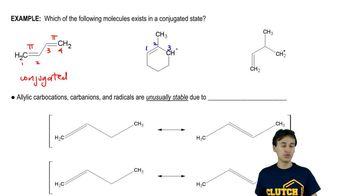
Conjugated states

Resonance Structures

Resonance structures are different ways of drawing the same molecule that illustrate the delocalization of electrons. In the context of conjugate bases, resonance can stabilize the negative charge by spreading it over multiple atoms. For instance, the acetate ion has resonance forms that contribute to its stability, making it a more favorable conjugate base compared to others without such delocalization.
Video consigliato:
03:04
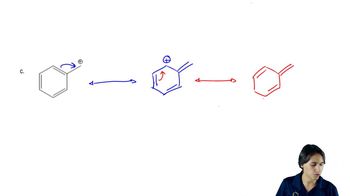
Drawing Resonance Structures

Acid Strength and Stability of Conjugate Bases

The strength of an acid is inversely related to the stability of its conjugate base; a more stable conjugate base corresponds to a stronger acid. Factors affecting stability include electronegativity, resonance, and inductive effects. For example, a conjugate base with a highly electronegative atom can stabilize a negative charge better, leading to a stronger acid. Ranking the stability of conjugate bases helps predict the relative strengths of the corresponding acids.
Video consigliato:
04:31
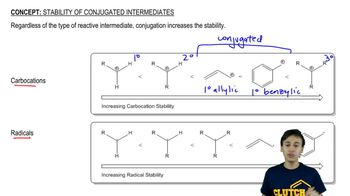
Stability of Conjugated Intermediates