

Ch. 2 - Acids and Bases; Functional Groups
Wade - Organic Chemistry 9th Edition
Wade9th EditionOrganic ChemistryISBN: 9780135213728Non è quello che usi tu?Cambia libro di testo
Capitolo 2, Problema 47b

The following compounds can all react as acids.
Structural formulas of five compounds: acetic acid, acetamide, methyl sulfonic acid, methyl sulfinic acid, and fluorosulfonic acid.
b. Rank the conjugate bases in the order you would predict, from most stable to least stable.

Guida verificata passo dopo passo
1
Identify the conjugate base for each acid by removing a proton (H⁺) from the acidic hydrogen. This will result in a negatively charged species for each compound.
Consider the stability of each conjugate base. Stability is often influenced by factors such as electronegativity, resonance, and inductive effects.
Evaluate the electronegativity of the atoms bearing the negative charge. More electronegative atoms can better stabilize the negative charge.
Assess the resonance stabilization. Conjugate bases that can delocalize the negative charge through resonance are generally more stable.
Consider any inductive effects. Electronegative atoms or groups near the negative charge can stabilize it through inductive effects, enhancing the stability of the conjugate base.

Risposta video verificata per un problema simile:

Questa soluzione video è stata consigliata dai nostri tutor come utile per risolvere questo problema.
Durata del video:
10m

Concetti chiave

Ecco i concetti essenziali che devi comprendere per rispondere correttamente alla domanda.

Acid-Base Chemistry

In organic chemistry, acids are substances that can donate a proton (H+), and their strength is often determined by the stability of their conjugate base. The more stable the conjugate base, the stronger the acid. This stability is influenced by factors such as electronegativity, resonance, and inductive effects.
Video consigliato:
02:49
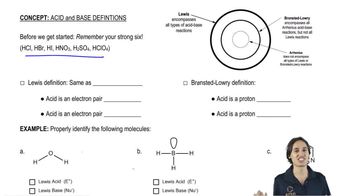
The Lewis definition of acids and bases.

Conjugate Base Stability

The stability of a conjugate base is crucial in determining the acidity of a compound. A stable conjugate base is less likely to re-accept a proton, making the original compound a stronger acid. Stability can be enhanced by resonance, where the negative charge is delocalized, or by electronegative atoms that can stabilize the charge through inductive effects.
Video consigliato:
04:31
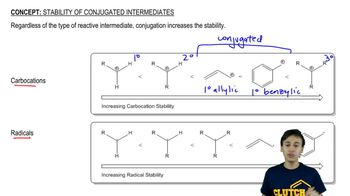
Stability of Conjugated Intermediates

Inductive and Resonance Effects

Inductive effects involve the transmission of charge through a chain of atoms in a molecule, often influenced by electronegative atoms like fluorine. Resonance effects involve the delocalization of electrons across multiple atoms, stabilizing the conjugate base. Both effects play a significant role in determining the acidity of a compound by affecting the stability of its conjugate base.
Video consigliato:
01:47
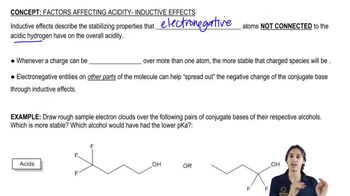
Understanding the Inductive Effect.