

Ch. 2 - Acids and Bases; Functional Groups
Wade - Organic Chemistry 9th Edition
Wade9th EditionOrganic ChemistryISBN: 9780135213728Non è quello che usi tu?Cambia libro di testo
Capitolo 2, Problema 47a

The following compounds can all react as acids.
Structural formulas of five compounds: acetic acid, acetamide, methyl sulfonic acid, methyl sulfinic acid, and fluorosulfonic acid.
a. For each compound, show its conjugate base. Show any resonance forms if applicable.

Guida verificata passo dopo passo
1
Identify the acidic hydrogen in each compound. For carboxylic acids (e.g., CH₃COOH), the acidic hydrogen is the one attached to the oxygen in the hydroxyl group.
For each compound, remove the acidic hydrogen to form the conjugate base. For example, removing the hydrogen from CH₃COOH results in CH₃COO⁻.
Draw the conjugate base for each compound. For CH₃CONH₂, removing the hydrogen from the amide group results in CH₃CONH⁻.
Consider resonance stabilization for each conjugate base. For example, the acetate ion (CH₃COO⁻) has resonance forms where the negative charge is delocalized between the two oxygen atoms.
Repeat the process for each compound, ensuring to show all possible resonance forms for the conjugate bases, such as for CH₃SOH, CH₃SO₂OH, and FSO₂OH.

Risposta video verificata per un problema simile:

Questa soluzione video è stata consigliata dai nostri tutor come utile per risolvere questo problema.
Durata del video:
11m

Concetti chiave

Ecco i concetti essenziali che devi comprendere per rispondere correttamente alla domanda.

Acid-Base Chemistry

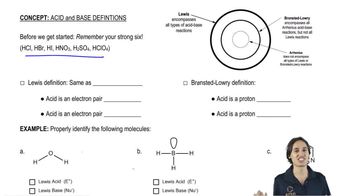
Acid-base chemistry involves the transfer of protons (H+) between molecules. An acid is a substance that can donate a proton, while a base is a substance that can accept a proton. In the context of the given compounds, each can donate a proton to form its conjugate base, which is the species remaining after the acid has donated a proton.
Video consigliato:
02:49
The Lewis definition of acids and bases.

Conjugate Base

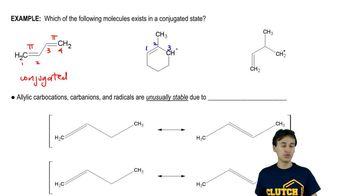
The conjugate base of an acid is formed when the acid donates a proton. It is crucial to understand the stability of the conjugate base, as it influences the acidity of the original compound. For example, resonance stabilization of the conjugate base can enhance the acidity of the parent acid by delocalizing the negative charge over multiple atoms.
Video consigliato:
03:27
Conjugated states

Resonance Structures

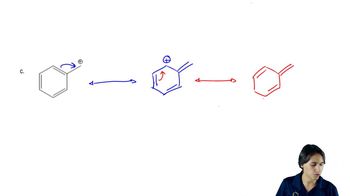
Resonance structures are different ways of drawing the same molecule, showing the delocalization of electrons. They are important for understanding the stability of conjugate bases, as resonance can distribute the negative charge over several atoms, stabilizing the conjugate base. In the given compounds, identifying possible resonance forms helps predict the relative acidity of each compound.
Video consigliato:
03:04
Drawing Resonance Structures