Ch. 2 - Acids and Bases; Functional Groups
Wade - Organic Chemistry 9th Edition
Wade9th EditionOrganic ChemistryISBN: 9780135213728Non è quello che usi tu?Cambia libro di testo
Capitolo 2, Problema 54a,b

The pKa of ascorbic acid (vitamin C, page 55) is 4.17, showing that it is slightly more acidic than acetic acid (CH3COOH, pKa 4.74).
Structural formula of ascorbic acid (vitamin C) showing hydroxyl groups for acidity comparison.
a. Show the four different conjugate bases that would be formed by deprotonation of the four different OH groups in ascorbic acid.
b. Compare the stabilities of these four conjugate bases, and predict which OH group of ascorbic acid is the most acidic.

Guida verificata passo dopo passo
1
Identify the four hydroxyl (OH) groups in the structure of ascorbic acid. These are the groups that can potentially lose a proton to form conjugate bases.
For each OH group, consider the deprotonation process: remove the hydrogen ion (H⁺) from the OH group, leaving behind an oxygen atom with a negative charge (O⁻). This forms the conjugate base.
Examine the stability of each conjugate base formed. Stability can be influenced by factors such as resonance, inductive effects, and the electronegativity of surrounding atoms. Resonance stabilization is particularly important in organic chemistry.
Compare the conjugate bases: The conjugate base that is most stabilized by resonance or other effects will correspond to the most acidic OH group. Look for conjugate bases where the negative charge can be delocalized over multiple atoms.
Predict the most acidic OH group: Based on the stability analysis, determine which OH group is most likely to lose a proton. The most acidic OH group will be the one whose conjugate base is most stable.

Risposta video verificata per un problema simile:

Questa soluzione video è stata consigliata dai nostri tutor come utile per risolvere questo problema.
Durata del video:
9m

Concetti chiave

Ecco i concetti essenziali che devi comprendere per rispondere correttamente alla domanda.

pKa and Acidity

The pKa value is a measure of the acidity of a compound, indicating the tendency of a compound to donate a proton. A lower pKa value means a stronger acid, as it more readily donates protons. In this context, ascorbic acid with a pKa of 4.17 is more acidic than acetic acid, which has a pKa of 4.74, meaning ascorbic acid donates protons more easily.
Video consigliato:
07:45
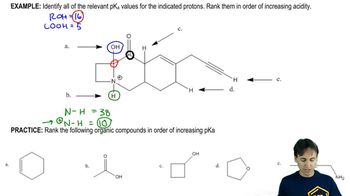
Identifying pKa values

Conjugate Base Stability

The stability of a conjugate base is crucial in determining the acidity of its corresponding acid. A more stable conjugate base results in a stronger acid. Stability can be influenced by factors such as resonance, inductive effects, and electronegativity. In ascorbic acid, the stability of the conjugate bases formed by deprotonation of different OH groups will help predict which OH group is the most acidic.
Video consigliato:
04:31
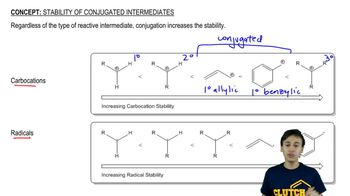
Stability of Conjugated Intermediates

Resonance and Electron Delocalization

Resonance involves the delocalization of electrons across adjacent atoms, which can stabilize a molecule or ion. In organic acids, resonance can stabilize the conjugate base by spreading the negative charge over multiple atoms. For ascorbic acid, analyzing the resonance structures of the conjugate bases formed by deprotonation of each OH group will help determine which base is most stable and, consequently, which OH group is most acidic.
Video consigliato:
03:32
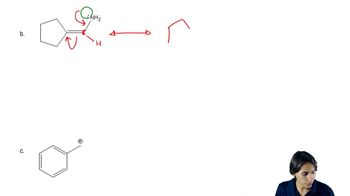
Drawing Resonance Structures
Pratica correlata
Domanda del libro di testo

Each of these compounds can react as a nucleophile. In each case, use curved arrows to show how the nucleophile would react with the strong electrophile BF3.

(e) CH3CH2OH

552
views

Domanda del libro di testo

The pKa of ascorbic acid (vitamin C, page 55) is 4.17, showing that it is slightly more acidic than acetic acid (CH3COOH, pKa 4.74).

c. Compare the most stable conjugate base of ascorbic acid with the conjugate base of acetic acid, and suggest why these two compounds have similar acidities, even though ascorbic acid lacks the carboxylic acid (COOH) group.

5238
views
1
rank
1
comments
Domanda del libro di testo

Each of these compounds can react as a nucleophile. In each case, use curved arrows to show how the nucleophile would react with the strong electrophile BF3.

(f) (CH3)2S

609
views
Domanda del libro di testo

Many naturally occurring compounds contain more than one functional group. Identify the functional groups in the ­following compounds:

a. Penicillin G is a naturally occurring antibiotic.

b. Dopamine is the neurotransmitter that is deficient in Parkinson’s disease.

1003
views
Domanda del libro di testo

Each of these compounds can react as a nucleophile. In each case, use curved arrows to show how the nucleophile would react with the strong electrophile BF3.

(a)

(b)

1209
views
Domanda del libro di testo

Many naturally occurring compounds contain more than one functional group. Identify the functional groups in the ­following compounds:

d. Thyroxine is the principal thyroid hormone.


785
views