Ch. 2 - Acids and Bases; Functional Groups
Wade - Organic Chemistry 9th Edition
Wade9th EditionOrganic ChemistryISBN: 9780135213728Non è quello che usi tu?Cambia libro di testo
Capitolo 2, Problema 53a,b

Each of these compounds can react as a nucleophile. In each case, use curved arrows to show how the nucleophile would react with the strong electrophile BF3.
(a)
(b)

Guida verificata passo dopo passo
1
Identify the nucleophilic site in each compound. In compound (a), the oxygen atom in the carbonyl group is the nucleophilic site due to its lone pairs. In compound (b), the double bond can act as a nucleophile due to the pi electrons.
For compound (a), draw a curved arrow from one of the lone pairs on the oxygen atom to the boron atom in BF3. This represents the nucleophilic attack on the electrophile.
For compound (b), draw a curved arrow from the pi bond to the boron atom in BF3. This shows the nucleophilic attack by the pi electrons on the electrophile.
Explain that BF3 is a strong electrophile because boron has an incomplete octet and can accept electrons.
Discuss the result of these interactions: in both cases, the nucleophile donates electron density to the electrophile, forming a coordinate covalent bond.

Risposta video verificata per un problema simile:

Questa soluzione video è stata consigliata dai nostri tutor come utile per risolvere questo problema.
Durata del video:
4m

Concetti chiave

Ecco i concetti essenziali che devi comprendere per rispondere correttamente alla domanda.

Nucleophiles

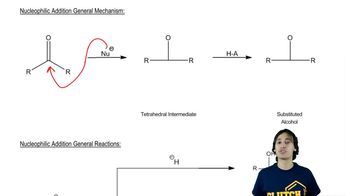
Nucleophiles are species that donate an electron pair to form a chemical bond in a reaction. They are typically negatively charged or neutral molecules with lone pairs of electrons. Understanding the nature of nucleophiles is crucial for predicting how they will interact with electrophiles, such as BF3, which are electron-deficient and seek to accept electron pairs.
Video consigliato:
08:27
Nucleophilic Addition

Electrophiles

Electrophiles are chemical species that accept an electron pair from nucleophiles during a reaction. They are often positively charged or neutral molecules with an incomplete octet, making them highly reactive. In this context, BF3 acts as a strong electrophile due to its ability to accept electron pairs, facilitating the nucleophilic attack.
Video consigliato:
03:
Nucleophile or Electrophile

Curved Arrows in Mechanisms

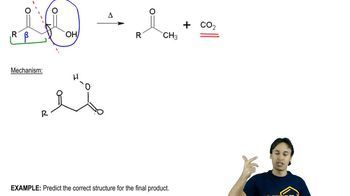
Curved arrows are used in organic chemistry to illustrate the movement of electron pairs during chemical reactions. The tail of the arrow indicates the source of the electrons, while the head points to where the electrons are going. This notation is essential for visualizing reaction mechanisms, particularly in nucleophilic attacks on electrophiles like BF3.
Video consigliato:
04:32
General Mechanism
Pratica correlata
Domanda del libro di testo

Each of these compounds can react as a nucleophile. In each case, use curved arrows to show how the nucleophile would react with the strong electrophile BF3.

(e) CH3CH2OH

552
views

Domanda del libro di testo

The pKa of ascorbic acid (vitamin C, page 55) is 4.17, showing that it is slightly more acidic than acetic acid (CH3COOH, pKa 4.74).

a. Show the four different conjugate bases that would be formed by deprotonation of the four different OH groups in ascorbic acid.

b. Compare the stabilities of these four conjugate bases, and predict which OH group of ascorbic acid is the most acidic.

1076
views
Domanda del libro di testo

Each of these compounds can react as an electrophile. In each case, use curved arrows to show how the electrophile would react with the strong nucleophile sodium ethoxide, Na+ −OCH2CH3.

a.

b. NH4+

1650
views
1
rank
Domanda del libro di testo

In each reaction, label the reactants as Lewis acids (electrophiles) or Lewis bases (nucleophiles). Use curved arrows to show the movement of electron pairs in the reactions. Draw any nonbonding electrons to show how they participate in the reactions.

c.

750
views
Domanda del libro di testo

Each of these compounds can react as an electrophile. In each case, use curved arrows to show how the electrophile would react with the strong nucleophile sodium ethoxide, Na+ −OCH2CH3.

(c) CH3CH2Br

(d) BH3

1471
views
Domanda del libro di testo

Each of these compounds can react as a nucleophile. In each case, use curved arrows to show how the nucleophile would react with the strong electrophile BF3.

(f) (CH3)2S

609
views