Ch.10 - Structure and Synthesis of Alcohols
Wade - Organic Chemistry 9th Edition
Wade9th EditionOrganic ChemistryISBN: 9780135213728Non è quello che usi tu?Cambia libro di testo
Capitolo 10, Problema 36a,b

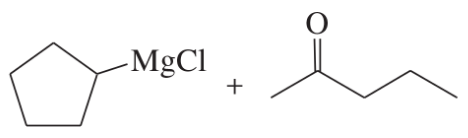
Draw the organic products you would expect to isolate from the following reactions (after hydrolysis).
(a)
(b)

Guida verificata passo dopo passo
1
Step 1: Recognize that the reaction involves a Grignard reagent (R-MgX) reacting with a carbonyl compound. Grignard reagents are nucleophiles that attack electrophilic carbonyl carbons, forming a new carbon-carbon bond.
Step 2: For reaction (a), identify the reactants: cyclohexylmagnesium bromide (Grignard reagent) and formaldehyde (H₂C=O). The Grignard reagent will attack the carbonyl carbon of formaldehyde, leading to the formation of a primary alcohol after hydrolysis.
Step 3: For reaction (b), identify the reactants: cyclopentylmagnesium chloride (Grignard reagent) and butanone (CH₃CH₂COCH₃). The Grignard reagent will attack the carbonyl carbon of butanone, leading to the formation of a tertiary alcohol after hydrolysis.
Step 4: After the nucleophilic attack, the intermediate alkoxide ion is formed. Hydrolysis (addition of water or acid workup) converts the alkoxide ion into the corresponding alcohol.
Step 5: Draw the organic products: (a) Cyclohexylmethanol (a primary alcohol) and (b) 1-cyclopentyl-2-methyl-2-butanol (a tertiary alcohol). Ensure the correct placement of the hydroxyl group and the new carbon-carbon bond in each product.

Risposta video verificata per un problema simile:

Questa soluzione video è stata consigliata dai nostri tutor come utile per risolvere questo problema.
Durata del video:
5m

Concetti chiave

Ecco i concetti essenziali che devi comprendere per rispondere correttamente alla domanda.

Hydrolysis

Hydrolysis is a chemical reaction involving the breaking of a bond in a molecule using water. In organic chemistry, it often refers to the conversion of esters, amides, or other functional groups into their corresponding acids and alcohols or amines. Understanding hydrolysis is crucial for predicting the products of reactions, especially when water is involved in the reaction mechanism.
Video consigliato:
Percorso guidato
1:00
Hydrolysis of Thioesters Concept 2

Reaction Mechanisms

A reaction mechanism is a step-by-step description of how reactants transform into products during a chemical reaction. It includes the sequence of bond-breaking and bond-forming events, which helps in predicting the structure of the products. Familiarity with common mechanisms, such as nucleophilic substitution or elimination, is essential for accurately drawing the expected organic products.
Video consigliato:
02:16
Heck Reaction Mechanism

Functional Groups

Functional groups are specific groups of atoms within molecules that are responsible for the characteristic chemical reactions of those molecules. Identifying functional groups in the reactants is vital for predicting the outcome of reactions, as they dictate how the molecule will behave during hydrolysis and what products will be formed. Common functional groups include alcohols, carboxylic acids, and amines.
Video consigliato:
02:36
Identifying Functional Groups